Muhoozi 'strips' Elwelu of rank, says over 20 Ex-soldiers arrested

A Kampala pastor is at the centre of a Shs2.9 billion alleged gold scam in which American investors are said to have lost money in a deal that promised them access to Uganda’s lucrative gold trade.
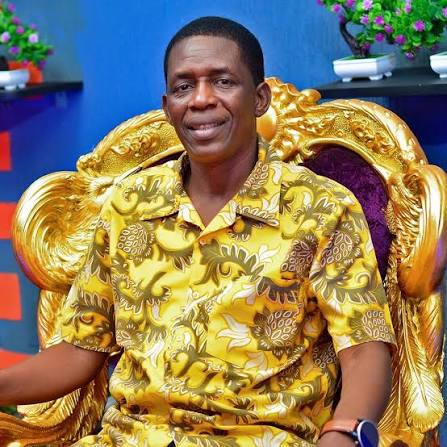
Pastor Solomon Mwesigye of Good News Church was arrested early October during an operation at his church premises as investigators moved against a suspected gold fraud network.
According to information gathered during the operation, the pastor reportedly admitted to investigators that he knew the American investors, although the circumstances surrounding his relationship with them and his alleged role in the transaction remain subject to investigation.
The case has once again thrown the spotlight on Uganda’s growing problem of gold scams, in which foreign investors are lured with promises of cheap or high-value gold before allegedly being defrauded through fake consignments, fictitious companies, bogus documents or demands for additional payments.
Uganda has become an important regional gold-trading hub, making the country attractive to legitimate investors as well as criminal networks.
A recent analysis by the Global Initiative Against Transnational Organized Crime found that fake-gold scams have become a prolific problem across East Africa, with Kampala and Nairobi emerging as important centres for schemes targeting foreign buyers.
The scams often involve the presentation of genuine gold, gold-plated metals, nuggets or powder to convince potential investors that a much larger consignment exists. Once confidence is established, victims are encouraged to transfer large sums of money.
Pastor caught in the gold web
The arrest of Pastor Mwesigye has added a new dimension to Uganda’s gold-scam problem because of his position as a religious leader.
Investigators are examining how the pastor became connected to the American investors, what representations were made to them, and how the Shs2.9 billion transaction was structured.
The pastor’s arrest does not, by itself, establish guilt, and the allegations will have to be tested through investigations and, if charges are brought, court proceedings. But the case illustrates one of the key weapons used by gold fraudsters: trust.
Gold transactions involve enormous sums of money, and foreign investors unfamiliar with Uganda’s networks can depend heavily on people who appear respectable, well-connected or influential.
A church leader can therefore provide something that is invaluable in a fraudulent transaction — credibility.
Investigators in Uganda have repeatedly warned that gold scams can take months to execute. Criminal networks may first establish relationships with prospective investors before introducing them to supposed gold dealers, lawyers, government officials, security personnel or company directors.
 Once the investor is convinced that the operation is legitimate, the money begins moving.
Uganda’s gold-scam epidemic
The pastor’s case comes against a backdrop of increasingly sophisticated gold fraud in Uganda.
In August 2025, the State House Investors Protection Unit held discussions with senior government officials over gold-trade fraud, with Energy Ministry Permanent Secretary Irene Batebe warning that fraudsters were mainly dealing in gold and that several investors had fallen victim to fake gold deals.
Police also reported in August 2025 that Shs900 million had been recovered from 56 people accused of scamming gold investors in Uganda over a seven-month period.
Investigators said the schemes normally take several months to execute, with members of the suspected cartels helping targeted investors process documents and navigate the supposed gold transactions.
The scale of the problem is illustrated by another case from April 2026, when businessman Muhammad Ali was remanded over an alleged Shs13 billion gold scam targeting foreign investors.
The case was brought by the State House Anti-Corruption Unit in collaboration with the Criminal Investigations Directorate and the Office of the Director of Public Prosecutions.
And in August 2026, police announced the arrest of 16 suspects, including four police officers, over an alleged $4 million fake-gold fraud scheme.
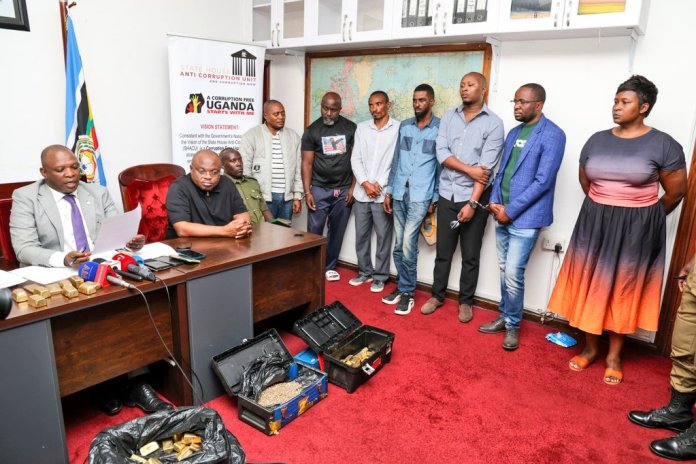
Police said the operation recovered suspected fake gold, documents and vehicles allegedly used to facilitate the enterprise. The authorities also alleged that four officers had abandoned their official duties and deployed themselves to guard suspects at an illegal gold refinery where the transactions were being facilitated.
The Malong case
 One
of Uganda’s best-known international gold-fraud cases involved South
Sudanese businessman Luol Lawrence Malong and his associates.
According to an account of the case, Malong and two co-accused were convicted after defrauding two Ethiopian businessmen living in South Africa of huge sums of money in a fake-gold scheme.
The case became an illustration of how international gold scams operate across borders, using Uganda’s reputation as a gold-trading centre to attract foreign buyers.
The wider regional investigation into fake-gold scams found that foreign investors from countries including Malaysia, India, Dubai, Ukraine, Korea and the United Arab Emirates have been targeted.
The pattern is remarkably similar: investors are offered gold at prices that appear unusually attractive, shown samples or documents designed to establish credibility, and then encouraged to commit increasingly larger amounts of money.
Foreign investors as prime targets
Foreigners are particularly attractive targets because they may have access to large amounts of capital while lacking knowledge of Uganda’s gold-trading networks. Criminals can exploit that information gap.
An investor arriving from the United States, Europe or Asia may not know which refinery is licensed, which dealer is genuine, how gold is assayed or which government agency is responsible for different aspects of the trade.
A fraudster can exploit that confusion by producing apparently official paperwork, introducing supposed government contacts or arranging meetings at impressive premises.
By the time the victim realises that something is wrong, millions or even billions of shillings may have changed hands. This is why investigators increasingly describe gold scams as organised criminal enterprises rather than simple acts of individual deception.
The attraction of Uganda’s gold
The country’s legitimate gold industry has grown significantly, further complicating the fight against fraud.
Uganda’s gold exports surged dramatically in 2023, reaching $2.3 billion from $201 million the previous year, according to Bank of Uganda data reported by Reuters.
 The
growth helped cement Uganda’s position as a regional gold hub, but it
also increased the opportunities available to criminals seeking to
exploit the sector. For legitimate traders, the repeated scandals are
damaging Uganda’s reputation.
Every foreign investor who loses money in a fake transaction becomes a potential source of negative publicity abroad, creating the impression that Uganda’s gold market is inherently fraudulent.
The authorities have consequently faced pressure to improve licensing, traceability, refinery oversight and verification of gold transactions.
A familiar formula
The alleged Shs2.9 billion transaction involving Pastor Mwesigye appears against this broader background. The most striking feature is not simply the amount involved but the use of personal credibility.
Gold scammers rarely begin by asking strangers to immediately send billions of shillings. They cultivate confidence.
They introduce intermediaries. They produce samples. They discuss export opportunities. They invoke government offices. They promise enormous profits.
And when the investor is convinced, the transaction becomes less about whether the gold exists and more about how much money the victim is prepared to commit.
The involvement of a pastor, if investigators establish that he knowingly participated in the alleged fraud, would demonstrate how far such networks can reach into respected sections of society.
For Uganda, the recurring cases raise a difficult question: how can the country attract legitimate foreign investment in minerals while preventing its gold sector from becoming synonymous with fraud? The answer will require more than arrests after investors have lost their money.
It will require stronger regulation, proper verification of gold dealers, tighter monitoring of refineries and greater cooperation between police, financial investigators, immigration officials and international law-enforcement agencies.
For now, investigators are expected to continue piecing together the alleged Shs2.9 billion transaction and determining exactly what role Pastor Mwesigye played.
The Americans who allegedly lost their money are likely to want more than arrests. They will want accountability, recovery of their funds and an explanation of how they were persuaded to trust a gold deal worth billions of shillings.
And as Uganda’s gold trade expands, the country faces an increasingly urgent choice: build a transparent gold market that attracts genuine investors, or allow fraudsters to exploit its riches and its reputation.
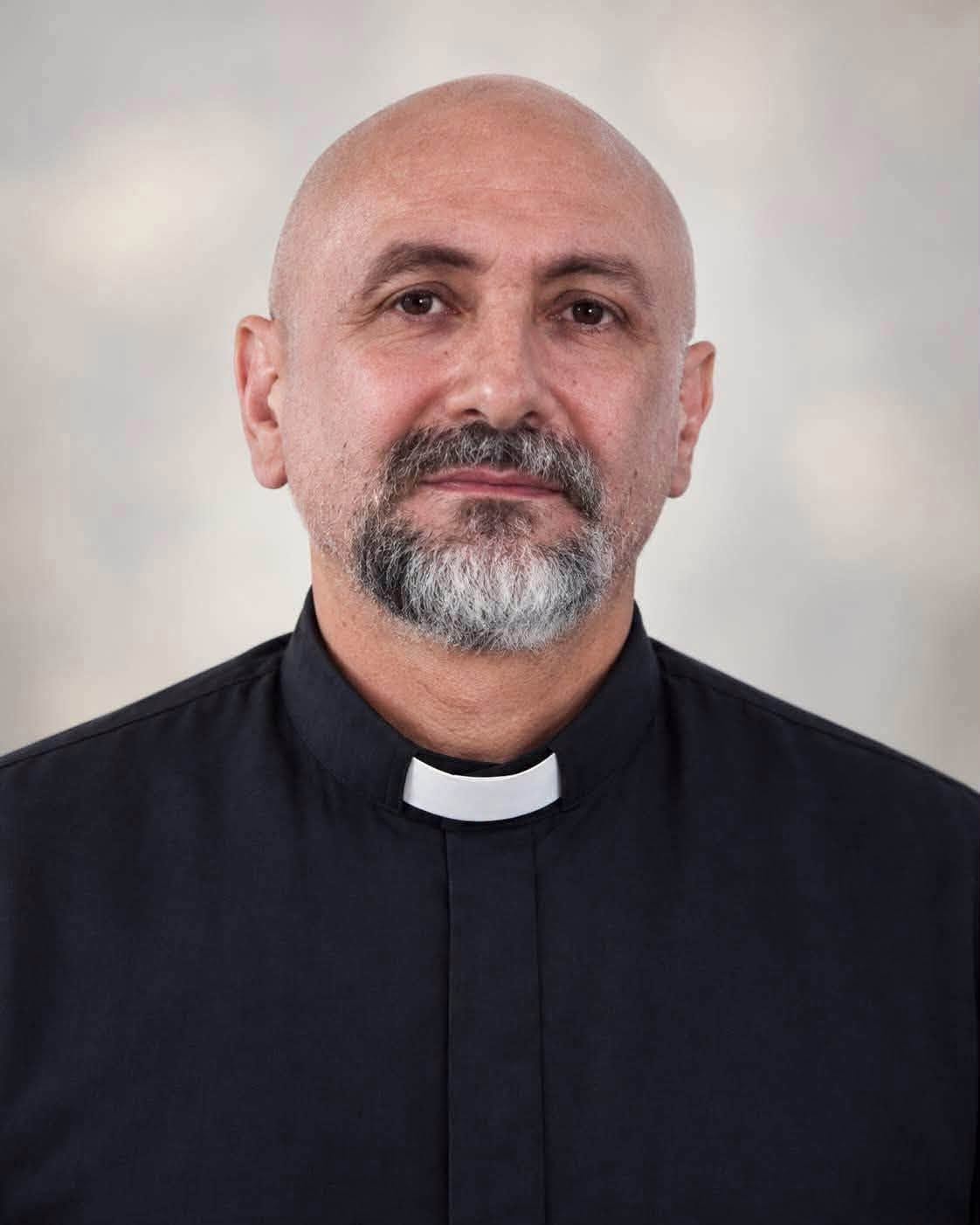
A priest in Ecuador was killed Oct. 17 after a crucifix fell on him during a livestreamed Mass.
The Archdiocese of Guayaquil confirmed in a Facebook post that the Rev. Patricio Alfredo Sánchez Molinari, 53, had died. The archdiocese said Sánchez Molinari was the parish priest of the Perpetuo Socorro Church in Guayaquil, about 165 miles southwest of Quito.
Footage from the livestream, reviewed by USA TODAY, showed Molinari delivering a sermon on the nature of life and urging those present to consider the quality of time spent with God and family.
"Dear brothers and sisters, one day all of us who are here will also die," Molinari said in Spanish. "Sometimes the time we have spent on things does not have the meaning of the time we spend with God. In that quality time that we give to God, our brothers, to our husband, wife, children, family, that time is the best spent."
The footage showed him leading the service from the altar and facing the congregation when the large crucifix detached from the wall behind him. Parishioners screamed after the crucifix struck him.
It is unclear what caused the crucifix to fall.
Molinari belonged to the Congregation of the Most Holy Redeemer, a Roman Catholic order founded in 1732 and approved by Pope Benedict XIV in 1749, according to the order's website.
"His dedication, priestly vocation, and love for others will remain forever in our hearts and will be an example of faith and hope for all who had the blessing of knowing him," the Perpetuo Socorro Church wrote on Facebook.
In a Facebook post, the Archdiocese of Guayaquil thanked those who had sent condolences from "different parts of the world" and for the "prayers for the eternal rest of the soul of Fr. Patricio Sánchez."
MUST READ:
The King
James Bible CALLS THE TRIBE OF JUDAH WHERE
JESUS COMES FROM BLACK
Judah mourneth, and the gates thereof languish; they
are black unto the ground; and the cry of Jerusalem is gone up.
(Jeremiah 14:2)
New
International WHITE PERVERSION
DELETES BLACK
“Judah mourns, her cities languish; they wail for the land, and a cry goes up
from Jerusalem.
(Jeremiah 14:2)
New Living WHITE
perversion DELETES BLACK
“Judah wilts; commerce at the city gates grinds to a halt. All the people sit
on the ground in mourning, and a great cry rises from Jerusalem.
(Jeremiah 14:2)
The King
James Bible CALLS THE CHILDREN OF ISRAEL BLACK
Our skin was black like an oven because of the
terrible famine.(Lamentations 5:10)
New King James
WHITE PERVERSION DELETES BLACKNESS
Our skin is hot as an oven, Because of the fever of famine.(Lamentations 5:10)
New American WHITE Standard Bible PERVERSION DELETES
BLACKNESS
Our skin has become as hot as an oven, Because of the ravages of hunger.(Lamentations 5:10)
GOD IS BLACK: THE VERSE ABOUT THE COLOR OF GOD THAT WHITE EDOMITES DO NOT WANT YOU TO KNOW
https://watchmanafrica.blogspot.com/2025/02/god-is-black-verse-about-color-of-god.html
The Bible is indeed black History: Bible verses that show that God is black and Black people are the true biological Israelites: The white man and the devil do not want you to Know these scriptures
https://watchmanafrica.blogspot.com/2024/05/the-bible-is-indeed-black-history-bible.html
King James was black: Part One
https://www.thepatriot.co.zw/old_posts/king-james-was-black-part-one/
Published on
September 18, 2014
By Simba Jama
KING
James the 1st of England was originally King James the 6th of Scotland.
He was the son of a black father and a coloured mother both of royal blood.
Without the necessary background, this may sound like a far-fetched story
motivated by a crazy desire to identify black heroes in world history.
We should not forget, however, that after the Moors settled in Spain and
southern Europe in 711 CE, significant numbers of black people found their way
into northern European countries such as Scotland, Ireland, France and Denmark.
The nations of Scotland and Ireland were, since the beginning of the first
millennium, had significant numbers of blacks, who in Scotland, wielded
political power as the kings and rulers.
It is also from the preponderance of black people in Ireland in medieval period
that the term ‘black Irish’ has continued to be used to this day.
After the downfall of the Moors in Granada, Spain, the white countries of
Europe took a special interest in Scotland because there was a thriving black
population there.
Unlike the Moors in Southern Europe who were Moslems, the Scottish blacks were
Christians and therefore could not be victimised on grounds of religion.
They also wielded significant military power.
To neutralise black influence in Scotland the neighbouring white nations
adopted the strategy of white washing the line of the black kings of Scotland.
They entered into treaties with the Scottish kings that would ensure
intermarriages between white princesses of the northern countries and the black
kings of Scotland and their heirs.
These were arranged marriages that would be overlooked by the Catholic Church.
King James the 4th of Scotland was made to marry Margaret, the daughter of King
Henry the 7th of England.
England was then still under the Roman Catholic Church and it was King Henry
the 8th of England who would later break away from the Catholic Church to form
the Anglican Church.
It was from James the 4th’s arranged marriage with Margaret that the Scottish
Kings began having a legitimate shot at kingship in England.
James the 5th was born to Margaret and would also be made to marry two white
French women and his second wife was Mary the daughter of the Duke of Guise.
This Mary gave birth to a daughter she named Mary and would inherit the
Scottish kingdom after the death of her father James the 5th.
She was known as Mary the Queen of Scotland.
Mary was a Catholic and the Queen of England hated her for this and also the
fact that Mary had a legitimate claim to the English throne through her
ancestors Henry 7th and grandmother, Margaret.
It was arranged that Mary (Queen of Scotts) be married to Edward the son of the
British King, Henry 8th.
In response, Mary’s mother, the daughter of the Duke of Guise, a Catholic,
condemned the arrangement and, the Queen of the Scotts had to decline the
marriage.
From then on, Italy, France and England began battling of influence for the
Scottish kingdom.
Mary’s mother as a daughter of a French Duke had been very influential during
Queen Mary’s reign, but when she eventually died, the Queen of Scotland became
isolated and vulnerable.
In 1565, Queen Mary was married by her cousin, a black Scottish man of the
royal family who was called Darnley.
Darnley was killed in 1567 by the white rivals of the Queen, but he had left
Queen Mary a male heir of her own lineage.
Queen Mary’s son was born a few months before his father’s murder and he was
named James the 6th.
James the 6th was, therefore, the son of a black man and a coloured woman.
The black man’s gene is dominant to the white man’s gene because the latter is
recessive.
When the two races meet through miscegenation, it is the white side which is
forced to die (recess); however the offspring loses some black characteristics
such as kinkiness of hair and darkness of skin, but only to a small extent.
This means James the 6th being a son of a black man and a coloured woman,
probably looked no different from any black man we see today.
The white nations were angered firstly by Mary’s refusal to marry Edward of
England and for that they murdered a man named Beaton who was an advisor to Mary
and her mother.
When Mary produced a black heir, she undid the generations of genetic
whitewashing that the whites had forced the Scottish kings to succumb to.
Darnley was killed for fathering Mary’s black heir.
Mary too would face imprisonment and Queen Elizabeth laid a heavy hand on her
because she was Catholic and she was a potential competitor to the throne of
England.
In 1587, Mary the Queen of Scotland was executed by order of Queen Elizabeth of
England.
King James the 6th then began ruling Scotland.
Although angered by his mother’s death, he did not retaliate against England.
Rather he looked at the situation diplomatically and realised that the Catholic
Church had no place in the region of Northern Europe anymore.
All the other nations of Northern Europe with exception of France were now
affiliated to protestant churches.
The Caucasian whites who were once known as barbarians had a bad history with
the Catholic Church and had been exploited and treated as less than humans by
the Roman popes and priests for over 1 000 years.
For this reason, protestant churches were popular in northern Europe and they
were named ‘protestant’ because they were in protest to the Roman Catholic
Church which was once considered orthodox.
King James the 6th thus made ties with the Anglican Church through associating
closely with the English.
Very quickly, he became an ally of England and an enemy of the Catholic Church.
Once England and Scotland were cooperating with each other, France could not do
much against the Scotts on behalf of the Catholics.
This angered authorities of the Roman Catholic Church because the church had
lost its dominion over the northern territories of Europe.
Meanwhile, King James was becoming great in his own country.
He was known for good governance and having a general sense of kingship which
lacked in many European nations at this time.
He treasured nobility, but conducted his duties with dignity and humility.
His government was orderly popular.
The kingdom of England was at this time lacking male heirs yet there was a
descendant of King Henry the 7thh (through Margaret) thriving in Scotland.
Before long, it became obvious that England was going to be under King James.
In 1603, King James the 6th of Scotland was crowned King James the 1st of England.
Scotland, England and Ireland were now all under his rule.
King James was black: Part Two
https://www.thepatriot.co.zw/old_posts/king-james-was-black-part-two/
Published on
September 18, 2014
By Simba Jama
A FEW months ago in the series ‘Moorish depiction in
European literature’ we referred to the ‘3D’ animation movie called Shrek.
This movie is about a green giant (ogre) who eventually marries a cursed
princess and becomes heir of a kingdom called ‘Far-Far Away’.
The princess’s curse was that she was white during the day and green during the
night and this probably meant that she was coloured (mixed race).
When Shrek married her she became permanently green (black).
The character Shrek has a Scottish accent throughout the movie and the issue of
kingship and miscegenation greatly links this movie to the story of King James.
The kingdom of Far-Far Away symbolises England and northern Europe because
those lands were once known as ‘the ends of the earth’.
Up to around the 1560s, the world map was right side up and had southern Africa
at the top and northern Europe at the bottom.
The Roman Catholic Church wanted to rule over northern Europe so as to spread
its influence in the lands occupied by Caucasian whites.
This was not to be because the kingdom had been won over by King James, a black
Scott.
The movie Shrek appears to be a satire of King James’ rule.
King James the 1st of England was the first monarch to rule the territory which
would be known as Britain or the United Kingdom.
This territory comprises Scotland, England and Ireland.
Generally northern Europe had set itself free from Catholicism and King James’
Britain was fully under the influence of the Anglican Church – a state
religion.
King James was a very good king who governed his kingdom well.
The influence of Britain began to grow under his rule because he strengthened
and united the navy and the armies of the region.
King James was also the one in power when Britain started making strides in
acquiring territory in America.
King James saw settling in America as a way of acquiring much needed land and
resources for his nation’s economy.
The idea was then promoted to the British nobles and people and it was popular
because it promised to bring commercial gain and also freedom from religious
persecution as they would be more distant from the oppressive Catholic Church
which was headquartered in Italy.
With careful planning, Britain managed to set up its first American settlement
at Virginia in 1607.
Virginia was eventually renamed Jamestown in honour of the great King James
1st.
From then on, Britain gained more territory and influence in America.
Before long, the British had colonies in Maryland and also Baltimore which
originally had belonged to a Catholic man.
New Netherlands was founded by the settler Jews in 1624, but by 1664 it had
become a British colony and was renamed New York after the Duke of Yorkshire.
From the rise of King James the 1st of England, Britain would become a notable
force in America and the rest of the world.
One thing that boosted British power and influence was King James’ involvement
in the project to translate the Bible into the English language.
Today many may know of the King James Version of the Bible, but few acknowledge
the impact that it had in promoting the English language and spreading British
influence.
Throughout the time that the Barbarians and other groups in Europe were under
the Catholic Church, it was not allowed to make copies of the Bible that was
not written in the Latin language.
But during the Moorish period, some of the Barbarian whites had been exposed to
Hebrew and Arabic versions of the Bible and they had come to find out that many
of the Latin scrolls of the Bible had been corrupted.
The likes of Martin Luther who openly rebelled against the Catholic Church and
was killed for it, were among some of the people who raised the alarm on the
corruption of the Latin scriptures.
By 1525, a man named William Tyndale, in guarded secrecy, produced an English
version of the Bible.
When the Catholic Church found out, Tyndale was imprisoned and killed by way of
burning.
Thousands of other people were killed too and the bulk of Tyndale’s work was
burnt to ashes although a few copies of the William Tyndale Bible exist to this
day.
King James was the first to succeed in perfecting the English translation of
the Bible.
He successfully distributed it around the world.
King James gathered Hebrew, Aramaic and Greek scholars who were also well
versed in the English language.
Many among these scholars were black.
Medieval Hebrew had been widely used by the Moors along with Arabic because a
large portion of the Moors were Israelites.
The blacks of Scotland had Ethiopian Hebrew ancestry and they shared the same
history of the Hebrew monarchs of Ethiopia.
This is the branch of Solomon’s son Menyelek which led to the founding of both
the Axumite and the Sabaean kingdoms.
King James himself could trace his ancestry to the tribe of Judah.
The name ‘James’ meant ‘to supplant’ was interchangeable with the name Jacob.
In Europe, the letter ‘J’ was not used until the time of King James whose team
of scholars who included some of Hebrew extraction was responsible for its
introduction in the English alphabet.
European nations would pronounce the name James as ‘Yames’ or ‘Hamish’. Jacob
in Europe was pronounced as ‘lacomus’ or ‘lacobus’.
Names like Judah and Jesus were pronounced as ‘Yahuda’ and ‘Yesus’ respectively
until the time of King James the 1st of England.
The reason for this ‘J’ replacing ‘Y’ was the difference in accent.
To this day, the Ethiopian Hebrews pronounce words such as ‘Yah’ as ‘Jah’.
Instead of saying ‘halleluiah’, Ethiopian Hebrews say ‘hallelujah’.
As King James was an Ethiopian Hebrew descendant, he used the letter ‘J’ to
pronounce biblical names in accordance with his dialect and accent.
The name Jesus was originally ‘Yahushua’ and meant ‘God saves’.
The King James scholars applied the ‘J’ to the word and it became Joshua.
In the New Testament, the Greeks had written down ‘Yahushua’ as ‘Yesus’ and
when the ‘J’ letter was applied to the ‘Y’, it became Jesus.
By 1611, the King James English Bible was out and this infuriated the Catholic
Church.
The book would make its way to America and to all British colonies.
In America, the settlers who were from different backgrounds had no common
language as yet.
The Jews spoke Dutch, the Spanish spoke Spanish and the Portuguese spoke Portuguese
and so on.
There was no standard American language until King James set up colonies in
America and introduced the King James English Bible in 1611.
The English Bible had a great impact on the Jews and they quickly adopted the
biblical names as was pronounced in the English language.
To adopt the word ‘Jew’ and not stress the name of ‘Yahu’ is evidence of
conversion on the part of the people who call themselves Jews today.
The Catholic Church hated King James for this act and they mocked him with racial
slurs throughout his life and after his death.
People like Anthony Welding would make up stories presenting King James as a
homosexual long after his death and this was all to tarnish his image.
King James had a wife with whom he had nine children and in the version of the
Bible he translated, his notion was that all homosexuals should be put to
death.
Anthony Welding was a white Catholic man who was once knighted by King James.
When King James found out what he was doing, he ejected him from his court.
King James and the ancient Scotts who were black were written about by the
likes of Anthony Welding as, “stinky people, who hold fornication, but a past
time. “Their flesh naturally abhors cleanliness; their breath commonly stinks
of pottage and to be chained with one of them, was to be tied to a dead carcass
and cast into a stinking ditch.
“I do wonder that King James should be born in so stinky a town as Edinburg, in
lousy Scotland.”
The racism here is clear.