Museveni fires son Muhoozi, promotes him to General
- Written by URN
President Yoweri Museveni has fired his son Muhoozi Kainerugaba as the commander of Land Forces, a day after he caused a diplomatic storm when he threatened to capture Kenya within two weeks. After dropping him, he promoted him to General, the highest rank in the Uganda People's Defence Forces (UPDF).
Muhoozi is replaced by Maj Gen Kayanja Muhanga, the current commander of Operation Shujaa who has since been promoted to Lt Gen, according to a statement from the UPDF. Muhoozi announced through his official handle, @mkainerugaba that he was on a mission to raze colonial borders and capture Nairobi.
The tweets which covered feeds since last evening sparked an online rage between Ugandans and Kenyans. Early this afternoon, the ministry of Foreign Affairs issued a statement reaffirming that Uganda treasures the existing strong bilateral relations between Uganda and Kenya based on the shared history between the two countries, common values, mutual respect, trust and the desire to build a unified East African Community.
The ministry added that the government of Uganda does not conduct its foreign policy and other official business through social media nor depend on social media sources in dealing with other sovereign governments.
While the discussion ensued, Muhoozi tweeted that he had held a discussion with his father Museveni and informed him that the younger East Africans have decided to make East Africa one nation. He however added that they had agreed on some changes, which would be announced later in the day.
“…Had a good discussion with my great father this morning. Apparently, my tweets scared Kenyans too much. He will announce the changes. There is a special prayer I shall make for our army,” Muhoozi said.
He added that during the discussion, he told his father that the younger East Africans have decided that they will be one nation and no amount of threats will stop them from that goal. Muhoozi has since edited his Twitter handle and removed the position of commander of Land forces. He has now replaced it with senior presidential advisor/special operations. It is not the first time Muhoozi's tweets are setting him on a clashing path with his father.
In April this year, during Muhoozi's birthday celebrations which were attended by Rwanda President Paul Kagame, Museveni publicly attacked his son and said his tweets might cause diplomatic troubles with other countries. President Kagame offered to edit Muhoozi's tweets before he posts.
Although Ugandans took Muhoozi's tweets about capturing Kenya as a joke, a large section of Kenyans seem to have taken them seriously with several politicians calling on President William Ruto, a close ally with Museveni to make a statement. Ruto brushed the tweets off and said they were the usual jokes Muhoozi usually makes on Twitter. After his sacking, Muhoozi has instead accelerated his Kenya tweets.

Uganda named worst digital rights violator
- Written by Frank Kisakye
At last week’s Forum on Internet Freedom in Africa 2022, in Lusaka, Zambia, Uganda drew unwelcome criticism. Speaker after speaker described the east African country as the worst global example of a digital rights violator.
The country’s recently passed ‘regressive’ Computer Misuse (Amendment) Bill, 2022 with a clause that criminalizes ‘misuse of social media, the passed and repealed social media tax, and the pre and post-election internet shutdowns shored up Uganda’s reputation as the worst ex- ample of an abusive regime of its citizens’ rights online.
It’s coming close to two years since the government shutdown Facebook ahead of the January 14, 2021 elections on suspicion of promoting then opposition candidate Robert Kyagulanyi of the National Unity Platform and in retaliation against the platform’s shutdown of over 220 accounts conspicuously created by the ministry of ICT to shore up President Yoweri Museveni and his son Muhoozi Kainerugaba’s popularity.
Access to the entire internet was blocked for nearly a week while access to other social media platforms was restored after a month. From Ghana MP Samuel Nartey George; Abigail Mpabwa Bridgman of Meta (Facebook) Oversight Board; Jillian York, the director for International Freedom of Expression; Victor Ndede from Amnesty International Kenya; Cecilia Maundu of International Association of Women in Radio and Television (IAWRT); Felicia Anthonio of Access Now and Moses Gowi from Kenya Human Rights Commission (KHRC), all condemned the continued blockade, saying it infringes on the citizens’ rights.
The forum organised by Collaboration on International ICT Policy in East and Southern Africa (CIPESA) attracted more than 500 participants from across the globe. At the same forum, Kenya received praise for keeping the internet on during the recent elections.
However, Victor Ndede, the campaigns officer for digital rights and policy, Amnesty International Kenya, said it was not for lack of wanting, but civil society engaged the government prior and pointed out the opportunity cost of shut- ting down the internet during elections.
“People would have poured on the streets and the government wouldn’t have wanted that,” said Ndede. Kenya’s conduct of
the pre and post-elections was under the global microscope. Many feared a recurrence of the 2007 election violence that claimed an estimated 1,500 people. However, few violent incidents were registered with the transparency of the electoral process praised for the upturn of events.
During the parallel discussions at the forum, Qemal Affagnon, the head of the West Africa division, Internet Sans Frontières, said the number of internet shutdowns is going down except for the dictatorial and military governments like Chad “which has the same tendencies as Uganda”.
Felicia Anthonio of Access Now said “an internet shutdown happens when your government decides that they don’t want you to express yourself. They don’t want the information you’re sharing to get out there. So, it is an intentional thing...a technical disruption of the internet is not a shutdown, it is intentional. What we have documented over the years is usually the government will issue an order to ISPs [Internet Service Providers] asking them to shut down the internet...The internet can be shut down in different ways; through slowing down the internet speed also known as throttling or shutting down social media platforms or cutting internet access completely. Sometimes you can have all three happening in one particular incident,” he said.
“In Uganda, we observed that in Decem- ber 2020, the internet speed was being slowed down, and then around elections, the government shut down social media, and then on the eve of elections the inter- net was shut down completely. Sometimes the internet is restored after elections. So, the question is what exactly is the purpose? What are you hiding? Why do you deny your people access to information? Internet shutdowns also question the credibility of elections...In another way, the human rights perspective to it is going to deny people access to the contestants, the politicians might not be able to speak to them, the human rights activists and election observers will also not be able to monitor and document what is happening in that particular country,” she added.
In 2016, the UN General Assembly passed a non-binding resolution that “declared internet access a human right.”
TOP10VPN, a tech firm that tracks inter- net disruptions across the globe, in its re- port, ‘Global Cost of Internet Shutdowns, said Uganda lost $109.7m or $3.8m (about Shs 13 billion) per day for a total of 692 hours (28 days) when the internet was shut down.
Levy, a Zambian participant with hear- ing impairment, said it gets worse for people with disabilities when they have shut off the internet. He called for more research and more sensitizing of PWDs on how they can circumvent internet shutdowns.
Ghana opposition MP Samuel Nartey George, however, called for more engagement between civil society and the governments saying sometimes social media and the internet can threaten national sovereignty and national security.
He called on African countries to unite and take on the social media giants like Facebook and Twitter. He said individual country actions like in Uganda, Ghana, Zambia will not get the tech giants to listen to the government’s concerns, especially in regards to sovereignty and national security.
- Written by URN
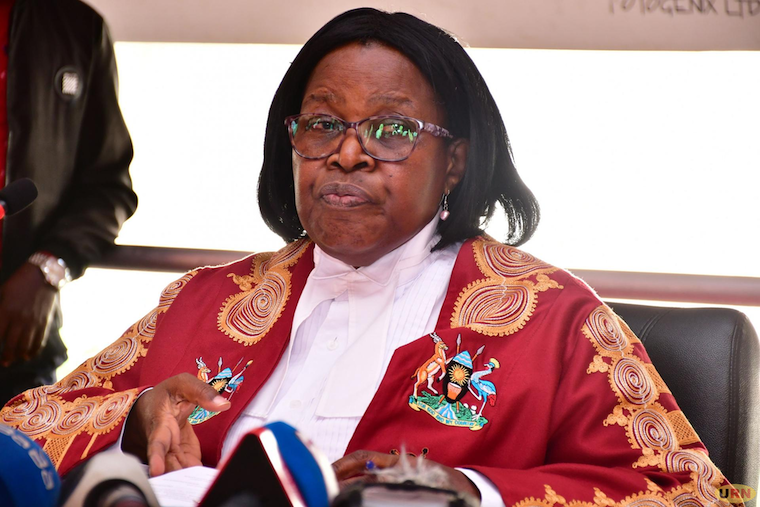
Chief Justice Owiny-Dollo sued by justice Esther Kisaakye
Supreme court justice Esther Kisaakye has sued her boss also the chief justice, Alfonse Owiny-Dollo and five judicial officials over what she termed as a continued witch hunt against her.
In the petition filed before the Constitutional court, Kisaakye who is seeking 24 orders among dozens of other declarations, wants the record showing that she has been away without official leave quashed and be assigned duties and reinstated as the administrative head of the Supreme court.
Jointly sued with Owiny-Dollo are Dr Pius Bigirimana the permanent secretary to the judiciary, Sarah Langa Siu the chief registrar of Courts of Judicature, Apophia Tumwine the commissioner of human resources judiciary, the Judicial Service Commission and the Attorney General.
Kisaakye says that effective March 18, 2021, during the presidential election petition case filed by Robert Kyagulanyi Ssentamu against President Yoweri Museveni, the respondents have jointly and consistently engaged in acts that are inconsistent with the constitution.
These actions she says include the confiscation of her file by Owiny-Dollo before she could read her decision arising from that presidential petition, closure of the Supreme court on the orders of the chief justice on March 19, 2021, and the issuance of a deceitful and defamatory press statement and denial of funds for her medical treatment.
The other acts listed by Kisaakye include the failure to recognize and or follow seniority at the Supreme court, secretive investigations against her disguised as a general inquiry, denial of leave, denial of her driver and bodyguards leave and allowances, refusal to allocate her work by the chief justice, withdrawal and refusal to reinstate her research assistant, denial of a letter of undertaking to her bankers and her subsequent removal from the judiciary and government payroll.
According to the evidence before the court, the chief justice directed police officers to close the Supreme court gate to prevent court users and the media from accessing the court and consequently prevented Kisaakye from delivering her ruling to the parties.
The evidence indicates that on the same day, Owiny-Dollo acting through the judiciary public relations office and the principal communications officer issued a deceitful and defamatory press release about what transpired at the Supreme court to all national and international media. According to Kisaakye, the said press statement carried malicious, damaging and false statements against her and as well as her work.
She adds that by virtue of her appointment, and terms of service she is entitled to medical treatment. But on October 1, 2020, and April 12, 2021, she requested for financial support for travel to the United States of America to complete her eye surgery and treatment which is not available in Uganda, and for the purchase of reading glasses. However, she adds, Bigirimana declined to release or refund the money despite the earlier medical board approval and commitment by the judiciary.
"That other justices of the Supreme court and other lower courts who required treatment outside the country have always been provided with resources by the judiciary to undertake such treatment out where such treatment is not available in Uganda," reads the petition.
It adds that the chief justice did not intervene to make sure that Kisaakye gets the necessary resources for her surgery, treatment, travel, and upkeep. The evidence before the court further shows that following the presidential election petition aftermath, Owiny-Dollo summarily removed Kisaakye as the administrative justice of the Supreme court and replaced her with justices junior to her.
"That constitutionally, the position of the administrator of the Supreme court is a preserve for the most senior member of the Supreme court after the chief justice... that the 1st respondent’s (chief justice) removal of your petitioner as administrator judge of the Supreme court replacing her with justices junior to your petitioner is inconsistent with articles.... of the constitution”, reads the petition.
It further shows that the Judicial Service Commission (JSC) started secretive inquiries against Kisaakye and solicited a complaint from Owiny-Dollo.
"On 6 April 2021, the 1st respondent/chief justice submitted a statement titled 'Referral of Justice Kisaakye' to the 5th respondent/Judicial Service Commission which was received on the same day wherein the 1st respondent/Owiny-Dollo attacked your petitioner for exercising her judicial independence and made abusive and derogatory statements against your petitioner among others about her mental health, character and upbringing", reads the petition.
It adds that whereas this was received by the Judicial Service Commission in April 2021, it was kept secret from Kisaakye until November 2021 when she was asked to respond to the same in 14 days.
“...But the 5th respondent/JSC singled out the petitioner for secretive investigations disguised as a general inquiry and neglected or ignored all other complaints made against other Justices of the supreme court and the 1st respondent/Chief Justice by the public, media report, Male Mabirizi and by Robert Kyagulanyi Ssentamu," adds the petition.
Kisaakye further argues that later on July 25, 2022, the Judicial Service Commission served her with a preliminary findings report on the events that happened during the petition and it is at this time when she realized that she had been under covert investigations a year earlier. She accuses the Attorney General/government to have on August 23, 2022, dismissed her grievances as being premature and not in violation of any provision of the constitution when brought to the government's attention.
Court records show that on March 3, 2020, the Judiciary human resource officer counted her leave days to be 181 days and submitted it to then chief justice Bart Katureebe who allowed her to take 35 days and deferred the rest. But when she asked for leave on December 22, 2020, Owiny Dollo allegedly ignored her and she kept working to date - having never received her signed forms.
"That your petitioner duly completed her leave and resumed her duties on June 2022 but the 1st and 2nd respondent turned around and accused your petitioner of having been away from the office without official leave since September 2021," says Kisaakye.
Through her lawyers of KBW Advocates, Kisaakye says it’s unconstitutional for Owiny-Dollo to exclude her from duty rosters and case lists and deny her work and also deny her bodyguards allowances because it is discriminatory and amounts to victimization.
"That your petitioner was consequently removed from the judiciary and government payroll and was not paid her salary and benefits for July and August 2022 to her great financial and social embarrassment, general inconvenience, mental anguish and adverse publicity and institutional ridicule," reads Kisaakye’s case.
Court records show that on August 24, 2022, Housing Finance Bank wrote to Kisaakye saying her salary had not been received from the judiciary and such nonpayment was going to adversely affect her salary loan repayment.
According to Kisaakye, all the accusations against the respondents were done without following due process and she wants the Constitutional court to determine if such actions are not inconsistent with dozens of the articles of the Constitution.
The lady justice further wants the court to order Owiny-Dollo to return her confiscated files and then after be allowed to deliver her rulings in the presidential election petition after. She also wants the judiciary press release of March 19, 2021, retracted from national and international press and removed from the judiciary website, and an apology published in the same national and international press and on the judiciary website for 5 years to remedy the damages caused to her and the Supreme court of Uganda.,
The Constitutional court Registrar earlier in the morning summoned the respondents to submit their defence within seven days after being served with a copy of this petition or else the court will proceed in their absence. Last week, lawyer Male Mabirizi also filed a case challenging some of the issues raised by Dr Kisaakye in her Constitutional petition.