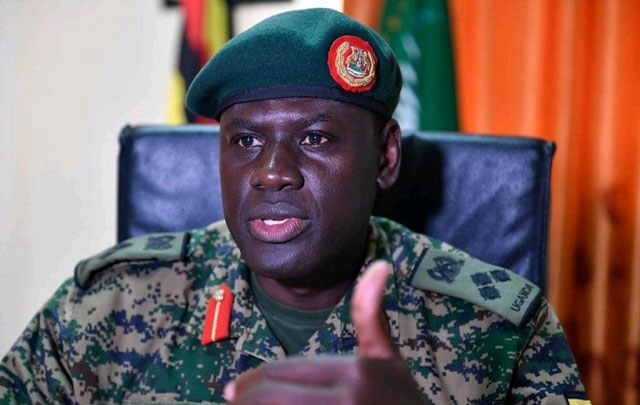
Deputy Inspector General of Police, Maj Gen
Paul Lokech
MUST
READ:
When Ugandan
Citizens loose complete trust in Government Postmortems: Aronda was Killed !
General Kasirye Gwanga : Weeps
https://watchmanafrica.blogspot.com/2015/09/when-ugandan-citizens-loose-complete.html
Birds of a
feather: when Babylon USA trains its slave states to kill and formally hide all
traces: MP Nebanda: Kalungi found guilty of manslaughter : Compare with: Lydia
Draru, found of manslaughter for killing Gen.Kazini
http://watchmanafrica.blogspot.ug/2014/02/birds-of-feather-when-babylon-usa.html
Draru, woman convicted of Gen. Kazini’s murder out of jail, going about
her business in the city
https://www.pmldaily.com/news/2021/08/draru-woman-convicted-of-gen-kazinis-murder-out-of-jail-going-about-her-business-in-the-city.html
Lydia Draru's kempt appearance counters Kazini murder
http://watchmanafrica.blogspot.com/2012/12/uganda-skeptical-about-mysterious.html
Will the
Nebanda-Kalungi trial be similar to the Dralu-Kazini trial?? Detectives say
they might prefer manslaughter charges against Mr Kalungi, accused of supplying
drugs that reportedly killed the Butaleja Woman MP
http://watchmanafrica.blogspot.com/2013/01/detectives-say-they-might-prefer.html
When questions
persist amidst lies: Kazini family wants fresh death probe
https://watchmanafrica.blogspot.com/2013/11/when-questions-persist-amidst-lies.html
Exposing
the Skelton in the USA’s slave state : General Sejusa accuses President
Museveni of Murdering opponents and colleagues
http://watchmanafrica.blogspot.ug/2013/08/exposing-skelton-in-usas-slave-state.html
General Sejusa Exposes
Museveni’s plan to assassinate Generals and cadres opposed to the plan to have
his son Muhoozi, as his successor(Muhoozi project) : Media houses closed and
under siege over publishing Gen. Sejusa’s Whistle blowing letter.
http://watchmanafrica.blogspot.com/2013/05/general-sejusa-exposes-musevenis-plan.html
'Muhoozi Project': By
Installing Son, Gen. Museveni Hopes To Defer Prosecution
http://watchmanafrica.blogspot.com/2013/05/muhoozi-project-by-installing-son-gen.html
Blood clot killed Maj Gen Paul Lokech, Police confirms
https://www.monitor.co.ug/uganda/news/national/blood-clot-killed-maj-gen-paul-lokech-police-confirms-3520800
Sunday August 22 2021
By Faith Amongin
The sudden death of the Deputy Inspector General of Police, Maj Gen
Paul Lokech, 55, was due to blood clot, the Uganda Police Force has
confirmed.
Maj Gen Lokech’s untimely demise which has since left the
nation in shock and set many tongues wagging, occurred Saturday morning
at his home in Kitikifumba, Kira Municipality in Wakiso District.
According
a statement by the Force’s spokesperson, Mr Fred Enanga, a team of four
pathologists carried out an autopsy on deceased General’s body in the
presence of four witnesses, that is - Brig Gen Dr Stephen Kusasira, the
Director Medical Services in the UPDF, the deceased’s personal doctor
Ben Khiingi, and two family representatives.
“The team of
pathologists established that the victim got a fracture of the right
ankle joint, around the end of July, 2021. It was a simple fracture
which was being managed at RUBY Medical Centre, by an Orthopedic
Surgeon. They put a POP cast at the victim’s leg and managed him as an
outpatient, with regular reviews. They further encouraged him to do mild
exercises while at home,” the statement reads in part.
“During the
autopsy, the pathologists opened the right lower leg which got injured
and found a very big blood clot that had formed in one of the big blood
vessels. They further opened his chest and found part of the blood clot
had been carried into the lungs. As a result, both vessels in the lungs
were blocked thus leading to the shortage in breath and subsequent
death. It was thus concluded as death due to natural causes,” Enanga
further explained.
The Force has also announced that the deceased
will be buried on Friday August 27, 2021, at Baibir Village, Ludele
parish, Pader Town Council in Pader District.
The body, according to
the program, will be taken to his home at Kitikifumba in Kira Division,
for prayers and viewing on Wednesday and then transported to Pader
District the next day [Thurdsay].
Having served in both the army and
police, Maj Gen Lokech’s burial will be with full honours from the
Police, while the gun salute will be presented by the UPDF.
“The pall
bearers are UPDF officers at the rank of Major General, while the sword
bearers are police officers at the rank of Commissioner,” the statement
reads.
![There have been several assassinations and mysterious deaths of high-profile officials in Uganda in recent years [File: AFP]](https://www.aljazeera.com/wp-content/uploads/2021/06/000_Par7874372.jpg?resize=770%2C513)
Ugandan minister wounded, daughter killed in assassination bid
https://www.aljazeera.com/news/2021/6/1/gunmen-kill-uganda-ministers-daughter-driver-in-failed-attempt
Gunmen sprayed Transport Minister Katumba Wamala’s car with bullets outside Kampala, killing his daughter and driver.
1 Jun 2021
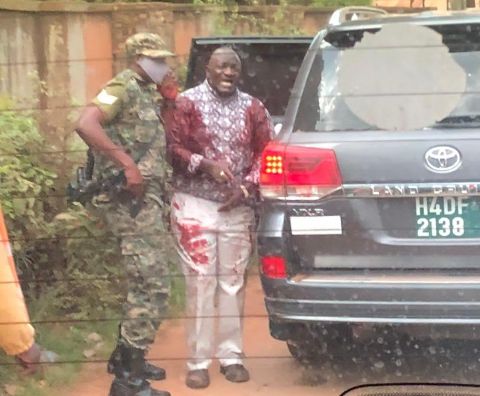
Gunmen have shot Katumba Wamala, Uganda’s minister of works and
transport, in what police described as a “targeted drive-by shooting”
which left the former top general’s daughter and driver dead.
Four attackers riding on two motorcycles with concealed number plates
followed Wamala from his home in the capital, Kampala, for 4km (2.5
miles) before they sprayed his vehicle with bullets shortly before 9am
(06:00 GMT) on Tuesday, a police statement said.
“A joint security task team is actively investigating a targeted
drive-by shooting,” Paul Lokech, deputy inspector general of police,
said in the statement.
“This is the first major shooting since 2019 and we strongly believe it was a targeted and not random incident.”
The style of the attack echoed that of several others over the years
in which many high-profile Ugandans have been killed, with the
perpetrators never brought to justice.
‘Organised crime’
The general’s daughter, Brenda Nantogo, and driver Haruna Kayondo
were killed in the attack, while another bodyguard survived. Wamala, who
once served as army chief, was wounded in an arm.
“The exact motivation towards the targeted shooting is
not yet established. We consider such attacks as a form of organised
crime, with a potential of extremism, aimed at undermining the
prevailing stability,” Lokech said.
White-clad forensic police swarmed the scene of the shooting, where
bullet holes riddled the rear and driver’s side of Wamala’s car – an
official army vehicle easily identified by its distinctive military
green number plates.
Wamala’s wife Catherine and a son also visited the scene.
In a video addressed to his children, Wamala spoke out about the attempt on his life.
“I’ve survived. We have lost Brenda. That’s God’s plan. I love you
guys. Please pray for mummy. Mummy’s in a terrible, terrible state,
please pray for her,” he said, his voice shaking with emotion.
In a statement posted on Twitter, Uganda’s President Yoweri Museveni slammed the attackers as “pigs who do not value life”.
“I talked to Gen. Katumba twice on the phone. He is being
well-managed,” he said, adding: “We already have clues to those
killers.”
Museveni said one of the bodyguards fired a warning shot which saved the general’s life, adding they should have “shot to kill”.
“We could be having a dead terrorist instead of scaring away the terrorists.”
Tuesday’s shooting was the latest in a series of attempted killings
of high-profile targets by motorcycle-riding assassins in Uganda’s
capital.
In June 2018, Ibrahim Abiriga, a leading politician from Museveni’s
National Resistance Movement party, was killed alongside his bodyguard
in similar circumstances.
In March 2017, witnesses described how Uganda police
spokesman Andrew Kaweesi was killed in a hail of bullets, also by four
masked assailants riding two motorcycles and near the site of the latest
attack on Wamala.
And in March 2015, Joan Kagezi, a prosecutor in charge of
investigating an attack in Kampala in 2010, was shot dead by men on
motorbikes as she returned home.
No one has been convicted of any of those killings.
Museveni said a new system of “digital beacons” on all vehicles and motorcycles would stop them from being used in crimes.
Uganda
Generals to die before Museveni's assassination
http://www.freeuganda.net/blogpost59-The-death-of-Maj-Gen-James-Kazini
By Timothy Kalyegira
Readers who might have followed my writings in the Daily Monitor's Saturday
column in 2006 and 2007 and listeners to the KFM radio talk show on Friday,
might have heard me mention on air or put in writing my meeting in July 2006
with a clairvoyant, a person with an uncanny gift for predicting future events,
the person I called the Seer.
In one of those columns or several of those KFM broadcasts, I did mention,
in 2006 and 2007, what the Seer told me would happen to Uganda in the years just ahead.
One of the things I told listeners clearly several times, for the record,
was that the Seer had told me that generals from ethnic tribes in western Uganda
would die one by one as the clock ticked on to the assassination of President
Yoweri Museveni, as foretold by the Seer.
It started with the Secretary for Defence, Brig. Noble Mayombo in May 2007
and has continued with the former army commander Maj. gen. James Kazini now in
Nov. 2009.
It has been reported by the mainstream media in Kampala that Kazini was murdered by his
mistress, Lydia Draru.
The facts of Kazini's death, in fact, point to what the Uganda Record knew
to be the truth yesterday, Nov. 10, 2009: that Kazini was killed for the same
reason that Mayombo was killed.
Two days before his death, according to well-informed sources, Kazini
received a phone call from the Chief of Military Intelligence, Brig. James
Mugira who asked Kazini: "Are you safe?"
Mugira then offered Kazini some escorts, to which Kazini angrily replied
that he did not need any security and he switched Mugira off the line. It is
not clear whether Mugira genuinely wanted to offer protection to Kazini or he
was, in fact, monitoring Kazini's movements on behalf of the hands that run the
Ugandan state.
This week, Kazini was scheduled to travel to southern Sudan. The white luxury Toyota
Landcruiser he owned was given to him as a personal donation and an act of
sympathy by the government of southern Sudan after he was court martialed
for the alleged creation of a false army payroll.
Southern Sudan, it should be remembered, still has a smoldering resentment
toward Uganda
because many, if not most, of them believe that the death of their leader Lt.
Gen. John Garang in July 2005 was orchestrated by Museveni.
It is not clear at this point whether the Ugandan state believed or
suspected that Kazini was being prepared by southern Sudan
or even Libya
to lead a possible military coup against the Museveni government.
But as the background given by the Uganda Record yesterday revealed, quoting
news reports and analysis from two Kampala
papers, the Independent and the Observer, it was publicly known that the state
believed Kazini had a plan or role to play in a plot to overthrow Museveni.
A source in Kampala has told the Uganda Record this: "About Kazini's
death, I one time overheard my uncle in the army say Kazini may join Col. Samson Mande and Col. Kiiza Besigye against M7
President Museveni.
He then said they the
state, presumably were going to eliminate the 'rebels' one by one. This is
not the last death of this year."
The true facts of Kazini's death, then are as follows: Kazini had a night
out on Monday, as has been reported by Kampala
newspapers.
What they do not reveal or know is that Kazini had parted company with his
mistress Draru. Later, he got a call from her.He had been in his military
vehicle but on receiving her call, his instinct was to get into his personal
vehicle, the Landcruiser, and head to Namuwongo, the suburb in Kampala near the
Industrial Area.
Waiting for Kazini at Draru's home were three burly men, commonly referred
to in Uganda
as "Kanyamas".
It is these three men, not Draru, who bludgeoned Kazini to death. An eight
year-old boy at Draru's home provided that evidence to the police when it
arrived at the scene but somehow this version of events was slowly withdrawn
from the public.
The first person to arrive at the scene of the crime was a woman called
Mabel, sister to Jovia Saleh, the wife of Gen. Salim Saleh. After Kazini's
murder, sources say, Draru phoned up Mabel and said "Come and pick your
body."
The reference by Draru to "your body" in making that call to Jovia
Saleh's sister, starts to shed light on to true facts of Kazini's murder.
At the mortuary at Mulago Hospital in Kampala,
Gen. Saleh's aide, Capt. Juma Seiko and a Colonel in Military Police took
charge of the body. Mourners and family members who arrived to view and treat
the body were screened by the Military Police and as one by one the relatives
and other mourners arrived, the Military Police officer made a phone call to an
unidentified person to get permission to allow each person to come in.
Capt. Seiko, with a long revolver strapped at his waist, kept a tight grip
over the proceedings.
All of this raised the question of why suddenly tight security and controls
should be imposed both at Namuwongo and at the Mulago mortuary, if Kazini's
death was the result of what is being reported, a drunken brawl between two
lovers.
At the wake at Kazini's home at Munyonyo, most of the army generals and
other high-ranking officers who had worked with Kazini over the years appeared
to commiserate with the family --- except Gen. Salim Saleh.
Sources who claim to know what is going on say that it was Salim Saleh who
made the phone call to Draru asking her to invite Kazini to her home on Monday
night and early into Tuesday morning.
The haste with which Lydia Draru was arrested, taken to the Central Police
Station for interrogation, arraigned before a magistrate at the Buganda Road
Court, and sent to Luzira Upper Prison where she spent Tuesday night, Nov. 10,
raises the level of suspicion even more.
She seemed eager to confess to having killed Kazini. She did not explain
what the iron bar that she reportedly used to hit Kazini, was doing in her
house.
As the media did what it did with Maymbo's death, publishing and
broadcasting the usual redundancies about Kazini the "fearless
commander" and "national hero" that Ugandan society and the
media typically heap on deceased public officials, the truth behind Kazini's
death remains out of public view.
But, as the Seer said, this is the trend that events will be taking prior to
that cataclysmic event soon to befall Museveni.
Salim Saleh haunted by Jet Mwebaze's death. Why?
In Sept. 1997, an army officer and brother to Brig. James Kazini, another
senior army officer, died in western Uganda under circumstances that
remain mysterious.
The then Minister of State for Defence, Steven Kavuma, gave conflicting
accounts of what had happened to the private plane carrying Mwebaze. The media
also reported various accounts.
Appearing on the Capital Gang talk show on 91.3 Capital FM at the time, the
then Lt. Gen. Salim Saleh was grilled by the then Mbarara Member of Parliament,
Winnie Byanyima, also a panelist on the Capital Gang, to explain what Saleh's
employees were doing on that plane in which Mwebaze was said to have died.
Saleh did not have an answer.
Maj. Gen. James Kazini the former army commander died on Nov. 10, 2009 still
convinced that his brother had been killed by the state or at least an actor in
the state.
But for several months, Saleh found himself almost unable to sleep. He
disclosed to some people that he was being haunted by the spirit of Jet
Mwebaze. Apparently it was tormenting him night and day.
On the day of Mwebaze's burial, an unusually heavy downpour of rain swept
over the area. It rained heavily and continually all through the burial proceedings
and convinced many onlookers that there was something suspicious about
Mwebaze's death.
In 1998, Saleh tried to find a way out of the nightmare he was facing. He
sought the help of a traditional fortune teller, a soothsayer of some sort, to
go to Mwebaze's grave and perform a number of rituals to appease the spirit of
Mwebaze.
A young man approached by Saleh refused to look up the fortune teller. Saleh
finally found another young man to go to Mwebaze's grave with the medium on his
behalf.
What happened, however, shocked Saleh. The young man, usually meek and
modest in personality, suddenly burst out into a loud wail when he met Saleh.
He shouted at Saleh and insulted him, speaking as one possessed by a strange
spirit or invisible force.
What happened next is not clear but this episode is a glimpse into the dark
and sinister world that Uganda's
leaders since 1986 live in.
Their abnormal lust for power and material things, their casual way with
shedding blood speaks not of ordinary human beings, but of people possessed by
what some might refer to as the spirit of death and murder.
It is this spirit in Museveni, his brother Salim Saleh, and Museveni's wife
Janet Museveni that I went to investigate in July 2006 when I met a Seer
outside Kampala.
I ended up discovering the most astonishing things imaginable.
But the net result of that experience was that all my fear of the state,
what it can do, and of Museveni vanished from me the next day. I had stumbled
onto what in the Bible is referred to as the "tree of the knowledge of
good and evil", the ultimate in knowledge of the deep mysteries of the
universe.
That spirit of death and murder hangs over the other leader in the Great
Lakes region of Central Africa, President Paul Kagame of Rwanda.
About Mwebaze's death, Saleh had planned to mobilise soldiers and army
veterans to go to the Democratic Republic of Congo to offer support security to
the new government of President Laurent Kabila.
But failing to successfully convince these men to go to Congo, the task fell to Mwebaze, who easily
assembled the men and these men waited for the flight at Entebbe International
Airport.
For whatever reason, Saleh started to view Mwebaze as threat to his power
and influence within the army and plotted against Mwebaze.
Just before Mwebaze was to have taken that flight, Saleh - convinced him to
give up on the military mission and instead fly to Congo on a diamond business
mission.
Mwebaze agreed to. Employees of Saleh's company, including some Israelis,
boarded a plane.
When the plane arrived in the skies over Kasese, it came down to the ground.
Later, Mwebaze was shot dead by the army in Kasese, then under the command of
Brig. Nakibus Lakara.
Who gave the order for Mwebaze's murder? Who else but the man who would later
be haunted by what he himself said was the spirit of Mwebaze.
It is no coinsidence that it is he, Saleh, who made the call to Lydia Draru
or Lydia Atim, asking her to call Mwebaze's brother to Namowongo, only for
three hit men, not Draru, to beat Kazini to death --- and then reports of a
domestic quarrel conveniently fed to the media.
According to NRA fighters in Luwero, Saleh was given the nickname
"Rufu" which in the languages of western Uganda means "death."
This nickname was not because of any extraordinary military achievements or
bravery on the battlefield, but rather, according to the former NRA guerrillas,
because it was to him that Yoweri Museveni entrusted the task of eliminating
Museveni's real or perceived enemies in Luwero.
These NRA veterans say that such major assassinations as that of the first
NRA commander, Lt. Ahmed Seguya and many others - were the core assignment of
Salim Saleh during their guerrilla war.
In Kampala,
most army generals, intelligence officers, and others familiar with the
workings of the NRM government do not believe that Kazini was killed by Lydia
Draru.
Maj. Gen. Kahinda Otafiire's melodramatic questioning of why God allowed
Kazini to die without first consulting he, Otafiire, reflects the amount of
fear being felt within top military circles than that Otafiire was trying to
express black humour.
The "Atmos-Fear" in Uganda after Kazini's murder
A mood of fear and conspiracy has come over Kampala since Monday night's murder of the
former army commander, Maj. Gen. James Kazini.
It is reminiscent of the days following the death of Brig. Noble Mayombo,
the Secretary for Defence, in May 2007.
Most people do not believe or do not want to believe that Kazini's death was
the result of a domestic fight between lover and mistress.
At Kazini's home on Tuesday night, the mood among the mourners, on its own,
spoke volumes, of people who believed there is more to this story than we are
being told.
Maj. Gen. Kahinda Otafiire, who had told the media several months ago as he
was arriving at State House Entebbe for a special NRM parting meeting that
"intrigue. Intrigue" was killing the NRM, has asked if Lydia Draru,
Kazini's mistress and alleged killer, might have worked with some conspirators.
If this is how much intrigue the atmosphere in Kampala has, we can only imagine what it is
like inside State House, the intelligence services where the deputy director
general of the External Security Organisation, Emmy Allio, no less, is living
in fear of his life, and within the Presidential Guard Brigade.
For the whole of last week, there was a rumour going round the country that
DP publicity secretary Betty Nambooze had died.
The fact that rumour, conspiracy theory, and fear are now the norm in Uganda,
itself paints an accurate picture of the state of governance in the country
today.
From now until the 2011 general election and quite possibly until Museveni's
time in office, Uganda
is going to grind down into an atmosphere of intrigue, unexplained murders,
"car accidents", and on and on.
Museveni is now at his most scared. The intelligence reports that Libya, with support from Rwanda and Kenyan Prime Minister Raila Odinga
were the hands behind the September riots in Buganda have now become the focus
of Museveni's thinking.
Just as Brig. Noble Mayombo's murder in May 2007 increased tensions within
the army and intelligence, Kazini's death is going to have many generals asking
when their turn will come.
The atmosphere of tension in Kampala will
soon equal that felt in the Rwandan capital Kigali where even government officials do not
truth their thoughts with their spouses.
Wednesday, 11th November 2009

President Museveni at the Malta Commonwealth
summit, Nov. 25, 2005.
By Timothy Kalyegira
Readers who might have followed my writings in the Daily
Monitor's Saturday column in 2006 and 2007 and listeners to the KFM radio
talk show on Friday, might have heard me mention on air or put in writing my
meeting in July 2006 with a clairvoyant, a person with an uncanny gift for
predicting future events, the person I called the Seer.
In one of those columns or several of those KFM broadcasts, I did mention, in
2006 and 2007, what the Seer told me would happen to Uganda in the years just ahead.
One of the things I told listeners clearly several times, for the record, was
that the Seer had told me that generals from ethnic tribes in western Uganda
would die one by one as the clock ticked on to the assassination of President
Yoweri Museveni, as foretold by the Seer.
It started with the Secretary for Defence, Brig. Noble Mayombo in May 2007 and
has continued with the former army commander Maj. gen. James Kazini now in Nov.
2009.
It has been reported by the mainstream media in Kampala that Kazini was murdered by his
mistress, Lydia Draru.
The facts of Kazini's death, in fact, point to what the Uganda Record knew
to be the truth yesterday, Nov. 10, 2009: that Kazini was killed for the same
reason that Mayombo was killed.
Two days before his death, according to well-informed sources, Kazini received
a phone call from the Chief of Military Intelligence, Brig. James Mugira who
asked Kazini: "Are you safe?"
Mugira then offered Kazini some escorts, to which Kazini angrily replied that
he did not need any security and he switched Mugira off the line. It is not
clear whether Mugira genuinely wanted to offer protection to Kazini or he was,
in fact, monitoring Kazini's movements on behalf of the hands that run the
Ugandan state.
This week, Kazini was scheduled to travel to southern Sudan. The white luxury Toyota
Landcruiser he owned was given to him as a personal donation and an act of
sympathy by the government of southern Sudan after he was court martialed
for the alleged creation of a false army payroll.
Southern Sudan, it should be remembered, still has a smoldering resentment
toward Uganda
because many, if not most, of them believe that the death of their leader Lt.
Gen. John Garang in July 2005 was orchestrated by Museveni.
It is not clear at this point whether the Ugandan state believed or suspected
that Kazini was being prepared by southern Sudan
or even Libya
to lead a possible military coup against the Museveni government.
But as the background given by the Uganda Record yesterday revealed,
quoting news reports and analysis from two Kampala papers, the Independent and
the Observer, it was publicly known that the state believed Kazini had a
plan or role to play in a plot to overthrow Museveni.
A source in Kampala has told the Uganda
Record this: "About Kazini's death, I one time overheard my uncle in
the army say Kazini may join Col.
[Samson] Mande and [Col. Kiiza] Besigye against M7 [President Museveni]. He
then said they [the state, presumably] were going to eliminate the 'rebels' one
by one. This is not the last death of this year."
The true facts of Kazini's death, then are as follows: Kazini had a night out
on Monday, as has been reported by Kampala
newspapers.
What they do not reveal or know is that Kazini had parted company with his
mistress Draru. Later, he got a call from her.He had been in his military
vehicle but on receiving her call, his instinct was to get into his personal vehicle,
the Landcruiser, and head to Namuwongo, the suburb in Kampala near the
Industrial Area.
Waiting for Kazini at Draru's home were three burly men, commonly referred to
in Uganda
as "Kanyamas".
It is these three men, not Draru, who bludgeoned Kazini to death. An eight
year-old boy at Draru's home provided that evidence to the police when it
arrived at the scene but somehow this version of events was slowly withdrawn
from the public.
The first person to arrive at the scene of the crime was a woman called Mabel,
sister to Jovia Saleh, the wife of Gen. Salim Saleh. After Kazini's murder,
sources say, Draru phoned up Mabel and said "Come and pick your
body."
The reference by Draru to "your body" in making that call to Jovia
Saleh's sister, starts to shed light on to true facts of Kazini's murder.
At the mortuary at Mulago Hospital in Kampala,
Gen. Saleh's aide, Capt. Juma Seiko and a Colonel in Military Police took
charge of the body. Mourners and family members who arrived to view and treat
the body were screened by the Military Police and as one by one the relatives
and other mourners arrived, the Military Police officer made a phone call to an
unidentified person to get permission to allow each person to come in.
Capt. Seiko, with a long revolver strapped at his waist, kept a tight grip over
the proceedings.
All of this raised the question of why suddenly tight security and controls
should be imposed both at Namuwongo and at the Mulago mortuary, if Kazini's
death was the result of what is being reported, a drunken brawl between two
lovers.
At the wake at Kazini's home at Munyonyo, most of the army generals and other
high-ranking officers who had worked with Kazini over the years appeared to
commiserate with the family --- except Gen. Salim Saleh.
Sources who claim to know what is going on say that it was Salim Saleh who made
the phone call to Draru asking her to invite Kazini to her home on Monday night
and early into Tuesday morning.
The haste with which Lydia Draru was arrested, taken to the Central Police
Station for interrogation, arraigned before a magistrate at the Buganda Road
Court, and sent to Luzira Upper Prison where she spent Tuesday night, Nov. 10,
raises the level of suspicion even more.
She seemed eager to confess to having killed Kazini. She did not explain what
the iron bar that she reportedly used to hit Kazini, was doing in her house.
As the media did what it did with Maymbo's death, publishing and broadcasting
the usual redundancies about Kazini the "fearless commander" and
"national hero" that Ugandan society and the media typically heap on
deceased public officials, the truth behind Kazini's death remains out of
public view.
But, as the Seer said, this is the trend that events will be taking prior to
that cataclysmic event soon to befall Museveni.
Draru, woman convicted of Gen. Kazini’s murder out of jail, going about
her business in the city
https://www.pmldaily.com/news/2021/08/draru-woman-convicted-of-gen-kazinis-murder-out-of-jail-going-about-her-business-in-the-city.html
by JAVIRA
SSEBWAMI | PML Daily Staff Writer
August
10, 2021

Lydia Draru was released from Prison after serving 14 years for man
slaughtering former army commander Maj James Kazini (PHOTO /Courtesy)
KAMPALA
— Lydia Draru, who served 14 years in prison for man slaughtering former army
commander Maj. Gen. James Kazini has been released, Prison authorities have
said.
Media
reports indicate Draru was released some months back and she is already going
about her business in Kampala.
A
Uganda Prisons spokesman Frank Baine on Monday August 9 confirmed her release
from the Luzira maximum penantiary.
Baine
is quoted to have said that Draru served and completed her 14 year long jail
term.
Draru
was convicted by the High Court for manslaughter and sentenced her to 14 years
in prison.
During
sentencing, Justice Monica Mugenyi acquitted Draru of the charge of murder, and
instead found her guilty of the lesser charge of manslaughter.
On
November 10, 2009 Gen. Kazini was found dead in a pool of blood at Namuwongo.
The
case had drawn broad attention and support for the defendant amid a national
reckoning with long-held taboos around domestic abuse.
Draru
admitted to hitting Gen. Kazini multiple times with an iron bar in self
defense, but told court but maintained that she did not intend to kill Kazini,
who was at the time her boyfriend.
By
the time she was sentenced, Draru had served two years on remand.
There
have been many conflicting statements surrounding the death of Gen. Kazini.
While court convicted Draru for killing the General, political commentators
believe Draru could not have killed the general single handedly.
Gen
Kazini was sacked as army chief in 2003 after UN accusations he plundered
resources in the Democratic Republic of Congo when leading operations there.
By
the time of his death, Maj Gen Kazini had fallen out with the NRM
establishment- having been found guilty of corruption the previous year. There
were other charges unconnected to the Congolese allegations.