Thursday, 18 December 2014

Kenyan Women With HIV Sue Kenya Government , Médecins sans Frontières (France) and Marie Stopes International Over Sterilisation

Women say their rights are being violated

HIV-positive women sue Kenya government and NGOs over sterilisation

Médecins sans Frontières (France) and Marie Stopes International named in lawsuit claiming violation of human, constitutional and reproductive rights


Forced sterilization of five women living with HIV in Kenya : Women Living with HIV & their Lawyers Issuing a Press Statement after Filing their Case.
Lawyer Allan Maleche with the HIV-positive women who are suing the Kenyan government and two NGOs after they were allegedly sterilised without their consent. Photograph: Regina Mwanza/Kelin


Five HIV-positive women in Kenya are suing the government and two top international NGOs, claiming they were sterilised without their consent.

The group this week filed a legal action against parties including the Kenyan health ministry, Médecins sans Frontières (MSF) and Marie Stopes International.

Meanwhile, activists protested in the capital, Nairobi, arguing that forced sterilisation is still widespread and should be be banned. The women marched from the high court to Uhuru Park with T-shirts that said: “Enforced and coerced sterilisation of women living with HIV”.

Lawyer Allan Maleche said his five clients were sterilised in health facilities in Nairobi county through a procedure known as bilateral tubal ligation. The various circumstances allegedly included: threats to withhold food portions and baby formula milk; inducement with the promise to pay medical and maternity fees; lack of provision of essential information to enable the women to make informed decisions; lack of provision of choices of other forms of family planning methods for the women.

Maleche said that one of the women was given two discount vouchers to reduce the cost of delivering her baby in hospital: one was for a caesarian but she did not realise the other was for tubal ligation.
“They have been psychologically affected, they have found it difficult when their spouse has left them for another spouse who can have more children,” the lawyer said on Thursday. “There is depression because something so valuable in their lives had been taken away from them. Their spouses wanted more children.”
MSF and Marie Stopes International did not directly carry out sterilisations, Maleche added, but allegedly referred the women to government hospitals where the operations were performed.

The lawsuit asks the court to make declarations including “the sterilisation of these women in these circumstances violated their human and constitutional rights” and “women living with HIV have equal reproductive health rights as all women including the right to freely and voluntarily determine if, when and how often to bear children”.

One of the group, Teresia Otieno, told the BBC: “I went in for an operation to give birth to my first child. By the time I was leaving the operation the doctor told me I had been sterilised.”
MSF said it had never encouraged surgical sterilisation as a preferred contraceptive method. Bilateral tube ligation was one contraceptive measure described to patients.

Dr Alexandra Vandenbulcke, MSF’s medical coordinator in Nairobi, said: “MSF takes these allegations extremely seriously and is reviewing them carefully. As a medical humanitarian aid organisation, MSF is committed to ensuring that all of our patients are fully informed about their medical options and that all of our patients provide full and informed consent prior to any medical treatment they receive.”

Faustina Fynn-Nyame, country director of Marie Stopes Kenya, said: “We are currently investigating the stories, but would be deeply concerned about any possibility that any woman had the kind of experience outlined in the report while under our care.

“If the accounts are accurate, they are wholly inconsistent with our principles of voluntarism, informed choice, and informed consent which are fundamental to our values, policies, and practices in all of the 38 countries we work in around the world.

“We will be working with government, private and NGO family planning providers in Kenya to determine the facts of these historical claims, and to reinforce our shared commitment to informed choice and informed consent.”

In 2012, a landmark report entitled Robbed of Choice, produced by the African Gender and Media Initiative, contained powerful testimonies from 40 Kenyan women who said they had been affected. Its author, Faith Kasiva, described the forcible and coerced sterilisation of poor, HIV-positive women as “systemic in public health facilities”.

She told TrustLaw: “We live in an African cultural setting where having a child or motherhood is glorified in a way that probably it’s not in other societies. A lot of these women, because they cannot give birth, they have been chased away from their homesteads. Others have been disinherited.”

The report quoted Selina, a 23-year-old woman, who said she was admitted to the Kenyatta national hospital in 2000 with tuberculosis and pre-term labour pains. She told how she underwent a caesarean section and, in the process, was sterilised after her husband signed the consent forms without her knowledge.
Her husband sent her away and married another woman because he “could not live with a woman who cannot give birth”, she was quoted as saying. “The sterilisation ruined my life.”

The women’s campaign received a boost in 2012 when a court in Namibia ruled that state hospitals illegally sterilised three HIV-positive women. The women had not given informed consent as they were presented with sterilisation forms just before or after giving birth, without being told what they were signing.
However, the judge did not feel there was sufficient evidence to prove that it was a discriminatory practice against women living with HIV.

MDG : Namibia sterilisation : Kayoso Pandeni
One of the three Namibian women subjected to enforced sterilsation who won a high court victory hailed as significant for women elsewhere. Photograph: Alex Duval Smith

Namibia court rules HIV-positive women sterilised without consent 

Sterilisations on three mothers carried out at same time as caesareans, but judge rejects claim that they were targeted because they were HIV-positive


MDG : pregnancy
The high court in Namibia has ruled in favour of three women who claimed they had been sterilised without consent. Photograph: Ian Waldie/Getty Images

In a landmark judgment for patients' and women's rights, the high court in Namibia on Monday ruled in favour of three women who claimed they had been sterilised without their informed consent. But the judge in the capital, Windhoek, rejected a claim that they had been targeted for sterilisation because they are HIV-positive.

The case, LM&MI&NH versus the government of the Republic of Namibia, is being watched by health rights campaigners around the world. In Africa – especially Kenya, Swaziland and South Africa – allegations have recently begun to emerge of state hospitals practising sterilisation of HIV-positive mothers.
The Namibian case, which began two years ago, was brought by the country's legal assistance centre on behalf of three women aged between 22 and 47 who had caesarean deliveries to reduce the risk of transmitting HIV to their babies. The sterilisations were carried out at the same time as the caesareans.
Facing a court room packed with campaigners wearing black T-shirts printed with the words "Non negotiable: my body, my womb, my rights", Judge Elton Hoff took two hours to read his judgment.
He said the three women in the case, who were sterilised in Namibian state hospitals between 2005 and 2007, had dealt with health staff who could not speak their language, Oshiwambo. They were handed consent forms containing unintelligible acronyms. The forms were produced while the women were in labour, minutes before they were wheeled into the operating theatre. In at least one case, the woman had been in labour for four days and was made to believe she would only be eligible for her caesarean if she signed the form. In all three cases, the women only realised the meaning of "BTL" – bilateral tubal ligation – after the surgery.

 'No one has the right to take away my womanhood and leave me at the mercy of the cruel and unfair judgments of my community' 

MDG : Namibia sterilisation : Ndinaomukulili Mooses
Ndinaomukulili Mooses says her life was ruined when she suffered coerced sterilisation during the birth of her daughter Theopolina. Photograph: Alex Duval Smith

The judge said: "There could not have been counselling in those circumstances. No woman should be required to sign forms during the height of labour. Such a practice is highly undesirable."


He dismissed the Namibian government's denial that the women had been forcibly sterilised, saying poor record-keeping in state hospitals left the government with no defence. "There is no indication in hospital records that plaintiff No3 had given her consent at any time before the surgery," said the judge.

While admitting that health workers in Namibian state hospitals face tremendous pressures, the judge called on the government to institute group counselling about contraception and to make information available in all languages necessary.

But although the judge said damages for the women could be discussed, he did not rule on an amount. He stopped short of ordering the government to issue a circular imposing a change of practice in state hospitals. The judge also claimed the women had not sufficiently proved that they were targeted for sterilisation because they are HIV positive.

Nevertheless, their lawyer, Amon Ngavetene, welcomed the judgment. He said: "I was happy that the judge said we are moving from medical paternalism to patient autonomy. This marks an important step forward for patients' rights. It means there is a need for health practitioners to look at ethical issues and record keeping. If the government is not prepared to settle out of court in terms of damages then we will obviously come back to court."

Ngavetene said the judgment marked a breakthrough in terms of people's perceptions of their rights. "In Namibia, because of our history, people think they have only been wronged by the government if it stops a protest or muzzles the media. This case highlights the fact that the government is responsible for the actions of the people it employs, it is expected to employ enough people and the right people."

About 13% of adults in Namibia are HIV-positive, according to UNAids. Anti-retroviral drugs are widely available and the use of Nevirapine – a drug treatment to prevent mother-to-child transmission of HIV – is widespread.

Cut and paste demonic Christianity : Chris Oyakhilome and the devilish Benny Hinn Anointing


He Must Have Learned It From Benny Hinn

http://galatiansfour.blogspot.ca/2014/12/he-must-have-learned-it-from-benny-hinn.html  

Tuesday, December 16, 2014


Chris Oyakhilome and the devilish Benny Hinn Anointing


 Chris Oyakhilome is a false pastor in Nigeria who has caused controversy pushing "faith healing" for Aids. It is sad to see so many fooled by that spectacle.


Source

5 comments:

Anonymous said...
And notice the "priest" at the bottom. Is he catholic or just trying to dress like one?

Benny Hinn is a catholic man anyway, he as much as admitted it. A fake just like the catholic "leadership" is fake.


 sherry said... Hi Bible believer,

I think that there are a lot of demonic spirits in the church today. This looks like witchcraft. I was witnessing to someone recently, and stated that I am unaware of one church in the U.S. that is not in apostasy. From my research, almost every church is a government run 501c3 church, and primed and ready to worship the antichrist. The few churches that I found that were not 501c3 were in some other serious deception. I don't think that Jesus is in organized religion, but I think that he can and may still wake some people up, and call them out. There are also huge megachurches around the world….ready to worship the antichrist. But I wonder if all these churches are going to worship the antichrist, then who will be going to the fema camps? There are so many fema camps and they are around the world as well. I just don't see that many 'true' Christians'....just (few) scattered around the world. What is your take on this? Thanks for your imput. Blessings, Sherry


Wednesday, 17 December 2014

UGANDA: REV. FR. PAUL BATAWULE, A CATHOLIC PRIEST HAS BEEN ACCUSED OF DEFILEMENT AND CHILD NEGLECT: The priest, who impregnated Namuddu in 2001 has since refused to look after their son. Namuddu, a former employee of Bukulula Parish narrates that she was sedated through a bottle of Soda given to her during one of the days spent at the priest’s house where she worked as a servant in 2000. Namuddu adds that on the fateful day, she unknowingly found herself lying on the same bed with the priest, who, contrary to the canons and celibacy vows, asked her to be his secret wife.


MUST READ

Uganda catholic church in disarray : Catholic Charismatic Priest Fr. Musaala exposes priest sex abuse scandals and advocates for end of celibacy and chastity among Diocesan priests


Archbishop Lwanga sacks Fr Musaala over sex claims


A Catholic sect that allows its priests to marry has registered and opened a branch in Uganda, with its headquarters in Jinja.


THE DAY A KENYAN CATHOLIC PRIEST WEDDED IN STYLE


Family won't drop Nebbi Catholic priest rape case

http://watchmanafrica.blogspot.com/2010/04/family-wont-drop-nebbi-priest-catholic.html

 Zimbabwe: Catholic Priest Raped Me, Says Maid

http://watchmanafrica.blogspot.com/2010/04/zimbabwe-catholic-priest-raped-me-says.html


betty1

Betty Namuddu breaking down during interview in which a priest is accused of neglecting her son


Masaka Catholic Priest Probed for Rape, Child Neglect 


For over 14 years, Betty Namuddu Mukisa, a resident of Kabale Bugonzi in Kalungu district has concealed information about a sexual encounter with a catholic priest Rev. Fr. Paul Batawule.

Today, Namuddu breaks the silence, revealing that she secretly fathered a child with the priest attached to Buyoga catholic parish in Bukomansimbi district. She not only accuses the priest of rape, but for child neglect and threatening violence.

Namuddu, a former employee of Bukulula Parish narrates that she was sedated through a bottle of Soda given to her during one of the days spent at the priest’s house where she worked as a servant in 2000. Catholic clergy are required to take a vow of celibacy and are not allowed to marry

Namuddu adds that on the fateful day, she unknowingly found herself lying on the same bed with the priest, who, contrary to the canons and celibacy vows, asked her to be his secret wife. Namuddu was 17 at the time. The encounter resulted into a pregnancy and a child who is now aged 13.

Our reporters accessed a birth certificate and Baptism cards indicating that Rev. Fr. Paul Batawule fathered the minor whose identities are concealed in order to protect his rights as a child.

However, Namuddu failed to secure child support from the priest because she was unwilling to maintain a sexual relationship, a condition given to her by the priest.

Namuddu had initially made secreted attempts to have the matter resolved by complaining to the Bishop of Masaka Diocese John Baptist Kaggwa. But her effort was fruitless and she became increasingly desperate after failing to keep her son in school.

The 13 year old child said that he has visited his father twice but he threatened violence against him. He says last month, his father threatened to kill him if he ever attempts to visit the parish again.

The matter has now been brought to the attention of Masaka Diocesan vicar Rev. Fr. Joseph Kato Ssempungu, John Baptist Kaggwa, the Bishop of Masaka Diocese and Cardinal Emmanuel Wamala.

Rev. Fr. Paul Batawule, the embattled catholic priest has declined to comment on the matter. , neither did Bishop John Baptist Kaggwa, of Masaka Diocese. But Fr. Joseph Kasangaki, the Information officer in Masaka Diocese says Fr. Joseph Kato Ssempungu, the former Diocesan Vicar General has been appointed to handle the matter.
Fr. Kasangaki however says in the meantime, they want Betty Namuddu to surrender the alleged son of the priest to Masaka Diocese.

Linos Ngompek, the Masaka RDC says he has also asked Mukasa Kityo, his counterpart in Bukomansimbi to investigate the matter since the accused priest is in his area of jurisdiction.

The news augments a request by Father Anthony Musaala, a popular catholic priest who recently wrote a letter to the archbishop of the Catholic Church asking that; “the church should do away with the vow of celibacy, saying it was time for “common sense to prevail” as many clergymen were already living with wives and children.”


In Uganda, we have heard many reports of Catholic priests, who have fathered children, those who have died of HIV/AIDS and many accused of engaging in sexual intercourse. But where does the Catholic Church get this teaching which has enslaved many would-be married priests who are quietly burning with the demands of nature? Apostle Alex Mitala, the overseer of National Fellowship of Born Again Pentecostal Churches, believes the Catholic Church got many things wrong as far as priesthood is concerned among which is the practising of the Old Testament priesthood of Aaron which creates a special priestly class distinct from other Christians. “In the New Testament, Jesus is the high priest and all of us as long as we are washed in his blood automatically become part of his priesthood. The New Testament priesthood is not, therefore, based on whether one is married or not or whether a person went to a seminary or not, as the Catholic Church teaches,” Mitala argues. Referring to Paul’s teaching in 1 Corinthians, Mitala, however, clarified that if a priest decides to remain unmarried it is acceptable. It only becomes a problem when that optional practice is enforced as a mandatory requirement to priesthood as the Catholic Church does. That teaching is not anywhere in the Bible. Even great Old Testament prophets like Samuel, Moses and many others had wives and so did the priests of the New Testament like Peter himself whom the Catholics considers to have been the first Pope,” Mitala elaborated. Mitala said he is a married man with six children and many other Pentecostal pastors are married and that in his observation, they may be better priests than those unmarried Catholic priests.( see, Is priestly celibacy biblical? http://watchmanafrica.blogspot.com/2011/01/is-priest-celibacy-biblical.html
 
A photo montage of Fr. Anthony Musaala (left) and Archbishop of Kampala Dr. Cyprian Kizito Lwanga 

MUST READ:

Fr Musaala hits back at Archbishop Lwanga


http://watchmanafrica.blogspot.com/2013/03/fr-musaala-hits-back-at-archbishop_3149.html


Fr.Anthony Musaala : Forgotten by the Uganda media but has made it in the LA Times: Uganda priest ostracized for publicizing sexual abuse


Catholic Cover up: Catholic church to set up an Ad hoc Committee to Investigate alleged sexual abuses by priests : Findings of the investigations, according to Archbishop Lwanga, would not be made public because the Church has a cocooned mechanism of resolving such slip-ups. Mean while Fr.A. Musaala has been ordered to shut up!!!


Masaka Catholic Priest Probed for Rape, Child Neglect - See more at: http://thetruthuganda.com/masaka-catholic-neglect/#sthash.XIgR1m2u.dpuf

Catholic priest accused of child neglect


Ms Namuddu and her son, who appeared at the RDC’s office in Masaka Town last Thursday. PHOTO BY MARTINS E. SSEKWEYAMA.  
By  Martins E. Ssekweyama

Posted  Wednesday, December 17  2014 at  02:00
In Summary
Refused. The priest, who impregnated Namuddu in 2001 has since refused to look after their son. 

MASAKA. A Catholic priest in Masaka Diocese has been accused of neglecting a child he fathered.
Ms Betty Namuddu, 31, of Kasaali in Bukulula Sub-county, Kalungu District reported the case to Masaka Resident District Commissioner Linos Ngopek, saying the priest, who is attached to Buyoga Catholic Parish in Masaka Diocese impregnated her but has since refused to provide for their 13-year old son.
The priest, whose name has been left out for legal reasons allegedly, impregnated Ms Namuddu in 2001 before she finished her secondary education at Centenary High School in Masaka Municipality.
Ms Namuddu, who came with her son to the RDC’s office last Thursday, claimed the priest raped her at Bukulula Catholic Parish where she was working then.

“The priest who would regularly demand for sex, one day asked me to stay behind after he had sent all the other girls for assignments. He invited me for tea but I suspect he had sedated it. Because after taking it I became weak. He took me to his bedroom where he repeatedly raped me,” she told Mr Ngopek.
“I found it hard to continue working there. So I left the place but I later realised I was pregnant. The doctor who examined me called the priest, who came and paid the bill but asked me to keep quiet about the matter.”

“I delivered at Kitovu Hospital but the priest who had earlier told me he would not be able to help me has since refused to look after our son.”

“I went to the police child protection unit but I was referred to the probation office. However, at the probation office I was told the Catholic Church is very powerful and difficult to prevail upon,” she said.
“I was advised to see Archbishop Cyprian Lwanga but I could not. Fortunately I was able to see Cardinal Wamala. I explained my dilemma and out of sympathy he gave me Shs60,000,” she said.

Ms Namuddu told Daily Monitor that Cardinal Wamala gave her a letter instructing the Bishop of Masaka to act on the matter decisively.

Bishop John Baptist Kaggwa and the then Vicar General Monsignor Joseph Kato Ssempungu, according to Ms Namuddu prevailed upon the priest, who promised to pay Shs500,000 every month as school fees and upkeep for the boy. However, he has since refused to honour the agreement and has never paid a coin.
Ms Namuddu, who had been teaching at a nursery school, lost her job on grounds that she had no proper qualifications.

Masaka Diocesan spokesperson, Father Joseph Kasangaki told Daily Monitor they are aware of the matter and are working on it.

However, we could not reach the priest as our calls to his known telephone number were repeatedly switched off but Mr Ngompek, told this newspaper he would cause a probe into the matter with a view of prosecuting the priest.
Issues
Aware. Although Daily Monitor could not speak to the priest, the Masaka Diocesan spokesperson, Father Joseph Kasangaki says they are working on a way through which the priest would be forced to take responsibilty of the boy and his mother.

The appeal. However Ms Namuddu, said whoever, is working on the matter should solve it precisely since she has suffered looking after their son with no defined means of income.

Cat and mouse games resume in the Great Lakes Region: Uganda to Start Repatriating Ex-M23 Rebels: 1000 ex-M23 rebels escape from Ugandan camp

which other player is missing???? The USA of course


MUST READ:

End of the M23 Era but no end yet to USA and her clients’ looting of Congo resources : Kabila Congratulates Congo Army for Defeating M23 Rebels: FARDC captured Ugandan and Rwandan Nationals fighting alongside M23 Rebels


1,320 DR Congo rebels cross to Uganda - army : DR Congo’s M23 rebel chief in Ugandan army safe house: Oh: really

http://watchmanafrica.blogspot.com/2013/11/dr-congos-m23-rebel-chief-in-ugandan.html  


Inside the western heart of darkness : The so called Western Pan African African Multi-national Companies looting mineral resources from D.R.Congo


Fooling us about Uganda’s neutrality in the Congo Conflict!!! Militarizing the Congo to help USA and allies to rape Congo resources: DRC troops, civilians fleeing to Uganda after rebel clashes


http://watchmanafrica.blogspot.com/2012/07/fooling-us-about-ugandas-neutrality-in.html

Add caption

Creating a Tutsi Empire in the great Lakes region as a Conduit of the American New world Order system : New UN reports accuses Uganda and Rwanda of Aiding M23 rebels: Uganda angered by latest UN report on Congo


Chaos by Design: When aggressors become mediators: When wolves pretend to be sheep: The US supports Museveni Congo mediation: M23 rebels capture Goma as the UN looks on: Kabila and Kagame fly to Kampala for talks


1000 ex-M23 rebels escape from Ugandan camp 

Publish Date: Dec 17, 2014
1000 ex-M23 rebels escape from Ugandan camp
Some of the repatriated ex-M23 rebels prepare to board a plane back to DRC. Photo by Roderick Ahimbazwe

newvision
ABOUT 1,000 former fighters from a Democratic Republic of Congo rebel group broke out Tuesday from a camp in Uganda where they were being held as soldiers were trying to repatriate them, the Ugandan army said.

"A thousand rebels from the M23 (group) have escaped" from the camp in Bihanga, about 300 kilometres (190 miles) southwest of the Ugandan capital Kampala, a spokesman for the Ugandan army said on the official Twitter account.


"They said they were worried about their safety if they were sent back to the Democratic Republic of Congo."


Several of the ex-rebels were wounded by gunshots after those in the camp refused to board army trucks sent in before dawn to take them to the airport, according to M23 chief Bertrand Bisimwa.


A Ugandan officer speaking to AFP on condition of anonymity admitted the operation had encountered "resistance" and confirmed that several in the camp were wounded by bullets.


The Ugandan army said the camp had been holding 1,373 former M23 fighters. An AFP reporter at Entebbe airport saw 120 of them board a plane bound for the DRC.


The Ugandan army spokesman, Lieutenant-Colonel Paddy Ankunda, said via Twitter that troops were now searching for the 1,000 "who escaped the repatriation".


He insisted that "no member of M23 was forced to be repatriated towards the DRC."


But in Kampala, where he lives, Bisimwa disputed that. He said the attempt to return the M23 former fighters to the DRC was "a violation of international law" and of a peace deal reached a year ago between the DRC and the group.


The rebels' 18-month war, during which they briefly seized the key DRC town of Goma, capital of mineral-rich North Kivu province, was brought to an end in 2013 by government troops and UN peacekeepers. The fighters fled into neighbouring Uganda and Rwanda.


They signed papers in May vowing not to fight again in return for a possible amnesty.


M23 leaders last month warned they would fight again should agreements fail. The defeated rebels told AFP of mounting frustrations among the group's confined-to-camp fighters.


While the M23 was defeated, multiple armed groups still operate in a region that has been in conflict for the best part of two decades.


Much of the rebel activity consists of abuses against civilians and illegal exploitation of natural resources such as metals, ivory or timber.
AFP

  
DRC to Start Repatriating Ex-M23 Rebels

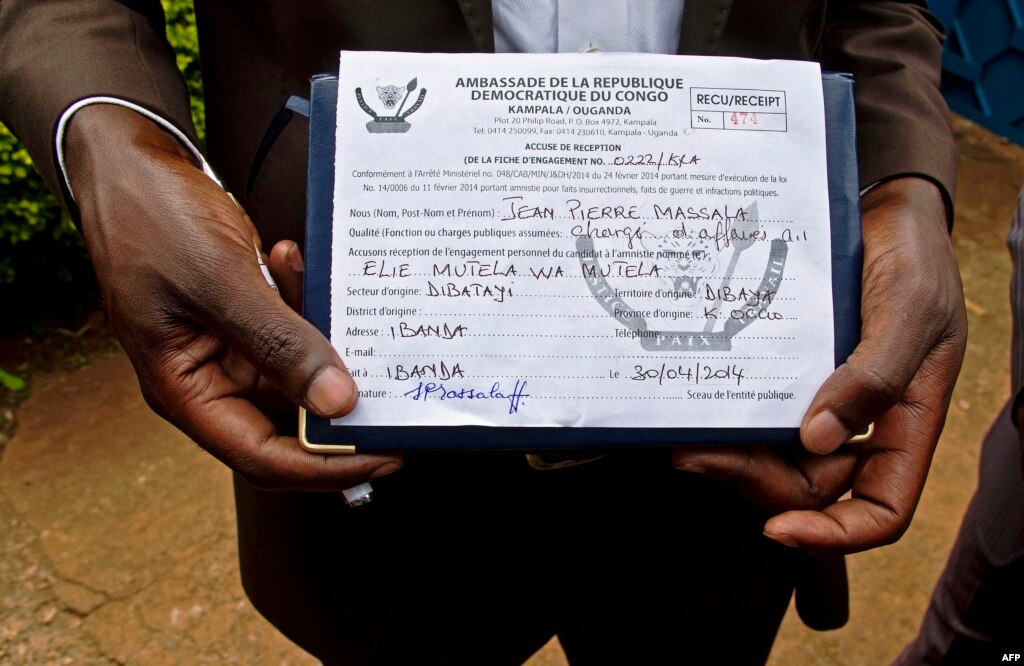
FILE - A member of the defunct M23 rebels holds an embassy form that could decide his eligibility for amnesty.

Reuters
Democratic Republic of Congo is to start repatriating former M23 rebels from neighboring countries, a government official said on Thursday, a process it hopes will prevent the defeated insurgents from regrouping.

More than a thousand fighters are believed to have fled into Rwanda and Uganda after Congolese and U.N. forces quashed the eastern rebellion in 2013. Most now live in military-run camps awaiting amnesties promised under a peace deal.

“They will leave behind their arms and proceed to the beginning of repatriation,” said Francois Muamba, the Congolese official responsible for overseeing implementation of the deal.
Congo has come under international pressure to speed up implementing the peace deal, which grants amnesties for former rebels who promise not to take part in any future insurrections. It does not apply to those wanted for war crimes.

Muamba said the repatriation mission by a high-level delegation was still awaiting a final approval from Rwanda. Rwandan officials were not immediately available for comment.
Uganda's State Minister for Foreign Affairs Henry Okello Oryem said a Congolese delegation was expected on Friday.

“We gave [Congo] a one-month ultimatum about six weeks ago to come and repatriate their people because they've been maligning us that we're protecting rebels,” he told Reuters.
Oryem said Uganda was hosting 1,430 ex-M23 fighters and had threatened to give them refugee status, which would allow them to circulate freely, something that would concern Kinshasa.
Rwanda and Uganda were accused by U.N. experts of supporting M23 with troops, arms and intelligence during the 2012-13 conflict, though both countries denied it.

In its most recent report, in June, the experts warned that M23 members were escaping from camps in Rwanda and there was growing evidence the movement was regrouping in Uganda.
Some 330 ex-fighters now in Uganda and 229 in Rwanda have so far been amnestied, Muamba said. More would be announced in the coming days, he added.

The former combatants will be sent to the Kamina military base in southeastern Congo to enter a demobilization and disarmament program.


Repatriation in Uganda turns violent

A bid by Ugandan authorities to repatriate former M23 rebels back to the Democratic Republic of Congo has turned violent. Dozens escaped en route to the airport. Ugandan troops were accused of wounding some ex-rebels.
The UN refugee agency said escaped M23 detainees, including some subject to war crimes probes, tried to find alternative refuge in Uganda on Tuesday, saying they feared retribution on return to the eastern Democratic Republic of Congo (DRC).

Ugandan military spokesman Ronald Kakurunga said dozens fled into the bush as 120 ex-rebels were being taken by truck to Entebbe airport on Tuesday.

They had belonged to a group of 1,300 March 23 Movement followers kept at a camp at Bihanga in southwest Uganda since Congolese and UN soldiers put an end to 20 months of insurgency in eastern DRC in 2012 and 2013.

At the time, hundreds of people were killed and 800,000 displaced. A regional accord stipulates that fighters suspected of war crimes could still be put on trial.

M23 spokesman Bertrand Bisimwa said Uganda's repatriation move on Tuesday was in "violation of international law."

He said M23 ex-rebels had first wanted firm protection guarantees from the DRC government, based in Kinshasa.
Killings in Beni region

On Tuesday, Human Rights Watch urged the International Criminal Court to probe more recent killings of scores of villagers in DRC's northeastern Beni region.

The UN mission MONUSCO and the army of DRC said that, since Saturday, they had begun a joint operation against a mainly Muslim rebel movement from neighboring Uganda, the Allied Democratic Forces (ADF).

MONUSCO has a mandate to protect civilians and neutralize armed groups.


MUST READ:


Kambale Musavuli: DR Congo: A prescription for lasting peace and stability

More Congo propaganda: M23 and the unseen high-tech genocide

Rwandan tabloid links Kagame to M23: President, Dr, Gen Paul Kagame on a Special visit to Uganda begging for another service


The American New World system and its Bogus elites: Former United States Under-Secretary for African Affairs, Jendayi Frazer questions the credibility of a report by a group of UN experts accusing Rwanda and Uganda of backing a rebellion in DRC:


Oh! God when will you avenge this: Congolese abandoned by international community

http://watchmanafrica.blogspot.com/2013/02/oh-god-when-will-avenge-this-congolese.html  

M23 Rebels Protest Forced Repatriation


Uganda Joint Christian Council (UJCC) clerics demand speedy electoral reforms as Pentecostal clerics keep silent.

Clerics demand speedy electoral reforms


Publish Date: Dec 17, 2014
Clerics demand speedy electoral reforms
Archbishop Stanley Ntagali noted that delays in the enactment of the electoral reforms is detrimental to the Electoral Commission’s road map. Photo by Norman Katend
 
By Pascal Kwesiga

CHRISTIAN religious leaders have asked government to speed up the process of amending electoral laws to introduce the necessary reforms that will deliver free and fair elections in 2016.

The Joint Christian Council (UJCC), in its Christmas message, noted that time is running out for the implementation of the electoral reforms demanded by Ugandans ahead of the 2016 elections.

With one year before Ugandans go to the polls to elect a new president, Mps and local government leaders for another five-year-term, the clerics, in a message read by the Anglican Church archbishop, Stanley Ntagali noted that delays in the enactment of the electoral reforms is detrimental to the Electoral Commission’s  (EC) road map.

The government called for proposals for amendments to the constitution and electoral laws from Ugandans last month. The opposition parties have submitted their proposals to the Uganda law reform commission.

Some of the electoral and constitutional amendments the opposition want include; disbanding the current EC and replacing it with an independent one, representation on EC, restoration of presidential terms and reduction of the powers of the president.

Some of the key reforms that ought to be implemented swiftly, according to the clerics, include the changing EC’s composition, appointment of individuals from various political parties as commissioners on the electoral body and “leveling” of the political playground.

Ntagali read the message at the Church of Uganda provincial headquarters at Namirembe, a Kampala suburb.

Sex before marriage necessary- Uganda gospel artist

Sex before marriage necessary- gospel artist
 

Publish Date: Dec 15, 2014
Sex before marriage necessary- gospel artist
Patrick Musasizi
Patrick Musasizi is a gospel artiste who goes by the stage name Chosen. Winfred Nagawa had a chat with him on sex, marriage and relationships

TELL US ABOUT YOURSELF
I am Patrick Musasizi, the 12th child out of 13. I am 24 years old and love making friends. I am simple, I love music, I enjoy spending time with family and stay away from anyone who puts me under pressure.

SO WHY THE NAME CHOSEN?
God chose me to be his special servant. He has guided me through my life journey.

WHAT INSPIRED YOU TO START SINGING?
I love listening to good vibes. One day I challenged myself to become a good singer. I said if others could do it then why not me. I loved Madoxx Ssematimba’s music and wanted to be like him.

ARE YOU DATING?
No.

WHY?
Because I am married to my career and besides, relationships consume time, energy and money.

SO HOW DO YOU HANDLE THE PRESSURE FROM THE GIRLS?
It’s hard some times, but I relate with them positively and make them my friends.

WHAT IS YOUR IDEAL KIND OF GIRL?
Hard working, patient, forgiving and God-fearing.

TALK ABOUT SEX BEFORE MARRIAGE
I believe one has to experiment to avoid future disappointment.


WHAT DO YOU HAVE TO SAY ABOUT GOSPEL ARTISTES GOING SECULAR?
Personally, I don’t crucify or judge anyone. Some people think secular music is anti-God, but the Bible preaches love, so I have no problem with people who do secular music.

WHICH LOCAL OR INTERNATIONAL ARTISTES DO YOU LOOK UP TO?
Ramain Virgo because of his good voice and the energy he uses in performance and locally Madoxx Ssematimba because of his beautiful lyrics and melodies.

WHAT DO YOU HAVE TO SAY ABOUT THE MUSIC INDUSTRY IN UGANDA?
The industry is prospering considering the past years since people sing and put a lot of life in the industry than before.
Besides, music is crossing boarders now and the market has widened. However, music as a sector still has a challenge with unprofessional players.

WHAT HAVE YOU ARCHIVED IN MUSIC?
I have a lot to say about music. It has taken me to school, I have supported my family, I have been introduced to many people and this has helped me to pass on my message, especially in my latest song

Follow me to Uganda.

WHAT ADVICE DO YOU HAVE FOR THE PUBLIC?
I urge Ugandans to love and respect their God and thank Him for all the good things they receive. They should pray in case they are hurt or face trouble.
 They should also be hardworking for better lives.