He is a Nazi, a reincarnation of Hitler's deputy Martin Bormann, a
baby killer, a philosophical hypocrite, and an enemy of civilisation. He
even wants to get rid of the Ten Commandments. He has been howled down
in Germany and denounced as "Professor Death" by the Wall Street
Journal. His appointment has become an issue in the US Presidential
election. His very presence on American soil has been greeted by
blockades and boycott campaigns from disabled-rights groups, Christians
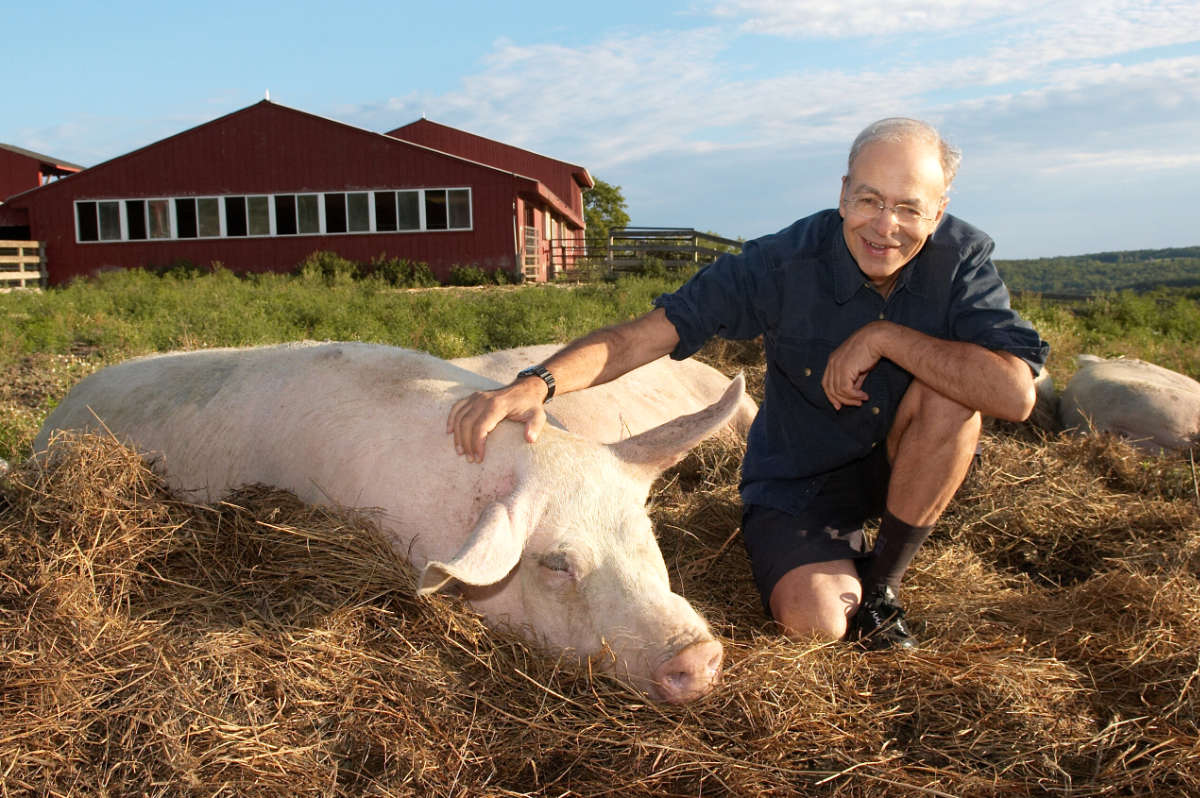
and good old-fashioned liberals. He is also a bespectacled,
softly-spoken 53-year-old Australian with wispy hair and bad dress
sense. His name is Peter Singer and he is, in the words of his enemies,
"the most dangerous man in the world today".
That's quite a description for an academic philosopher from an
obscure university, Monash, in Western Australia. But Singer's
appointment to Princeton University's Professorship of Bioethics has
detonated an academic bomb right in the quad of one of America's most
prestigious Ivy League universities, provoking a thousand hostile
editorials and a firestorm of rage in the American establishment. The US
Presidential candidate Steve Forbes, a Princeton Trustee and alumnus
whose family has given many millions to his alma mater , declared he
would withhold all future donations. "Peter Singer rationalises
invidious discrimination against the unborn, infants, the infirm and the
elderly," said Forbes. The appointment of Singer, declared the Wall
Street Journal in an editorial, "leads us to wonder by what criteria
Princeton might exclude a Nazi or Japanese scholar who saw nothing wrong
in the medical experiments on prisoners of war and targeted populations
during World War II."
The
venom of Singer's critics straddles the globe. "His book, Practical
Ethics, is full of fallacies, half-truths, and the most obnoxious
philosophical errors," says Dr Richard Oderberg, a philosopher from
Reading University. "I think it is morally questionable that Singer
should have a place at Princeton. Already we allow the killing of the
infant in his mother's womb. But Peter Singer wants to take it one step
further. He wants to justify the killing of the infant outside the womb,
in the rocking chair."
But like some ancient Stoic philosopher demanding more punishment,
Singer appears to thrive on the antagonism he generates. "My views are
perceived to be threatening by a segment of this society, and it's a
segment that comes largely from the Christian viewpoint. And that
segment feels in some sense of crisis because it has lost some important
battles, notably the abortion battle. I state my opposition to that
viewpoint more bluntly than most people do. This is a society that does
need to hear some of the things I've got to say."
It's not hard to understand why some people might hate Peter Singer.
He believes humans are no different from animals; a chimp could have a
greater right to life than a human infant. And sometimes killing human
babies, he argues, is the right thing to do.
Singer's first day as a Princeton lecturer in late September this
year was marked by a mass wheelchair blockade of the main university
building by the Not Dead Yet disabled-rights group. Chanting, "Children
Have Rights I want Singer Terminated - CHRIST - and "We love our
crippled lives," the 250-strong protest group, with six television crews
in tow, brought Princeton's classes to a standstill. There were 14
arrests. Along with their chants, the Not Dead Yet group also held up
placards denouncing Singer's philosophy: "No one should have to prove
their personhood."
It
was a clever slogan; the definition of "personhood" is a key concept in
Singer's work. But the philosopher was stony faced. Humour is not one
of his strong points. "Does it mean that every member of homo sapiens is
automatically a person, even if they are an anencephalic [a child born
without a whole, or part of, a brain] or something like that. Then you
would have to say something about why the anencephalic human being is a
person and a fully intact chimpanzee is not. Yes, I know that the word
'person' is in common use, and I know that I am trying to shift it by
suggesting that non-human animals could be 'persons' and that some
humans might not be 'persons'. But that is a way of getting people
involved in species membership. And try and get them to break this
automatic nexus between species membership and moral status."
In 1975, Singer published Animal Liberation, denouncing homo sapiens'
tyranny over animals. Born in patriotic, steak-loving Australia,
Singer's own conversion to the animal-rights cause came famously in the
cafeteria queue at Oxford University, somewhere near the spaghetti
bolognese counter, when some English postgraduate friends refused the
meat sauce on the moral ground that it was wrong to kill animals. Singer
was mystified - then fascinated. Within two months, Singer, then an
Oxford philosophy postgraduate, and his wife, Renata, had converted to
vegetarianism, then veganism - foregoing dairy products or the wearing
of wool or leather.
Singer is not some gushing pet lover; he made it clear in the book
that he did not particularly like animals. But Animal Liberation is full
of vivid descriptions of humanity's cruelty to animals. It attacks the
institutional cruelties we impose on animals through the
five-battery-chickens-to-a-cage factory-farming methods we use to
produce cheap meat or the inject-it-into-the
rabbit's-eyes-and-see-if-it-hurts school of cosmetic product testing. It
was in these angry pages that Singer coined the term "speciesism", akin
to racism, to describe humanity's arbitrary discrimination against
other non-human animals.
As a political treatise, Animal Liberation has had enormous
influence. It has sold half-a-million copies and has become the bible of
the animal-rights movement. Every time you meet a militant vegetarian
you are meeting a disciple of Peter Singer. Its ideas are regurgitated
daily across a million dinner tables. It is this
ingesting-what-you-preach and donning-what-you-declare that marks Singer
out from other philosophy academics, whose metaphysical ponderings into
the nature of the external world ends at the seminar door.
He even stood as a Green candidate in the 1996 Australian election.
Singer, who dresses in cottons and plastic Doc Martens, is not
interested in abstruse intellectual debate just for the sake of it. He
wants to change the world with his ideas (his thesis was on civil
disobedience). "There would be something incoherent about living a life
where the conclusions you came to in ethics did not make any difference
to your life. It would make it an academic exercise. The whole point
about doing ethics is to think about the way to live. My life has a kind
of harmony between my ideas and the way I live. It would be highly
discordant if that was not the case."
He
looks fit - he was casually dressed like a hill-walker, even at
Princeton - and appears to be very self-contained. He speaks in a dry,
slow Australian drawl. He hardly ever raises his voice and is
surprisingly unemotional about those critics who denounce him even as
"Herod's propaganda minister" - "I guess I was more impressed by the
Wall Street Journal until I read this stuff against me."
How people decorate the spaces they use tells you something about
their soul. If that is true, then Singer's soul must be remarkably
functional. His office, deliberately hidden away in the recesses of the
Center for Human Values building to foil would-be assassins, contained
almost nothing of a personal nature and, surprisingly for an academic,
very few books.
Singer states his arguments rather than trying to win you over;
their truth, to him, is self-evident. You can argue with him - he sounds
temperate, and is not inflexible around the edges - but I doubt if you
could ever shake his own certainty in his position. His critics say he
is cold-hearted, a philosophical Danton, who has no real understanding
of how people actually work.
Singer is a utilitarian, a follower of the 19th-century philosophers
Jeremy Bentham and J S Mill, who formulated the treatise that the best
moral good was the happiness of the greatest number. In utilitarianism,
an action is judged not by its intrinsic nature, but by its
consequences. The crucial and only important moral question is, does it
reduce suffering and/or increase happiness?
The second tenet of utilitarianism is the idea of "equality of
interest". The pleasures derived by a rich sweatshop owner from
exploiting his workers, profits, increased leisure time, do not count
more highly than the pain, fear and suffering of the workers.
There is no room for emotion in this cool calculation of suffering or
pleasure; even the interests of your own child do not count for more
than those of a complete stranger. Singer does espouse a more
sophisticated version of utilitarianism than Mill, known as "preference
utilitarianism", where actions are not judged on their simple
pain-and-pleasure outcome, but on how they affect the interests, the
preferences, of anyone involved.
There is one further key question for a utilitarian such as Singer:
Where do the limits of our moral universe stop? What sort of beings
should we include in the sum of interests? The entire canon of western
religion, morality and philosophy is constructed on the notion that only
human beings, only people, have a right to moral consideration; animals
are different. But what is it about us humans, Singer argues, that's so
different? It's such a fundamental philosophical question that
sometimes it's hard to grasp. From our very first experiences, we learn
to treat human beings differently from all other creatures. To challenge
that notion seems absurd, nonsensical - you cannot "murder" a cow.
What
is it to be human? Opponents of Singer would talk about
self-consciousness, the ability to reason, the possession of language,
tool-making or having emotional states such as sadness. But studies of
chimpanzees taught sign language by US researchers over the past 30
years prove that none of these attributes is unique to humans; mature
trained chimps can display the deductive reasoning skills of something
like a human three-year-old. Even domestic dogs display problem-solving
skills and suffer from grief. And it's clear that some human beings,
small infants, those in a persistent-vegetative state or those in the
advanced stages of a degenerative disease such as Alzheimer's, do not
have any of these characteristics. It's simply not possible to construct
a defensible, absolute rule about some unique human quality that
excludes all animals without also excluding some human beings.
We are, in Singer's view, simply being "speciesist" when we drip
detergent on to a rabbit's eye rather than carrying out the same
procedure on a human patient in a persistent-vegetative state. "To give
preference to the life of a being simply because that being is a member
of our species would put us in the same position as racists who give
preference to those who are members of their race," he states. According
to Singer, the true moral boundary for the equal consideration of
interests is not being human, or being rational, but in having the
capacity to suffer. Animals suffer by being chopped up for human dinner
tables; ergo eating meat is morally wrong. Our trivial human desire for a
nice juicy steak is outweighed by the cow's vital desire not to be
eaten.
Singer is not detested because he eats miso soup and supports animal
rights, but because he denies the sacredness, the sanctity, of human
life. For Singer, the lives of higher beings, beings that have
rationality or self-consciousness - "persons" - are more important than
mere sentient beings. If you came across a child and a dog drowning and
you could only save one, you would be under a moral obligation to save
the child.
But for Singer, not all persons are humans, and some humans are
definitely not persons. An adult chimpanzee can exhibit more
self-consciousness, more personhood, than a new-born human infant. Under
Singer's worldview, if you came across a new-born infant, who had no
family, and a mature chimp and could only save one of them, you might
actually be under a moral obligation to save the chimp.
"Killing them [infants], therefore, cannot be equated with killing
normal human beings, or any other self-conscious beings. No infant -
disabled or not - has as strong a claim to life as beings capable of
seeing themselves as distinct entities existing over time," he states in
Practical Ethics. At one stage, the ever-practical Singer proposed a
post-natal 28-day qualification period during which infants -
non-persons at that stage - could be killed.
The idea sounds preposterous, but are Singer's theories so
far-fetched? In Britain, since the 1967 Abortion Act, we have
effectively operated a dual standard - human foetuses are denied rights
and the protection of law. And yet in premature births we strive to our
utmost to preserve human life. Logically, there is no real difference
between the potentially disposable human material in the womb and the
sacred, inviolable human rights that are conferred upon the baby at
birth. Singer merely takes this one step further and argues that
new-borns are not "persons" and do not, therefore, deserve the full
status of legal protection.
The
debate on Singer's ideas almost always revolves around disabled
infants, those with severe conditions such as spina bifida, but his
reasoning clearly applies to any human new-born rejected by his parents
for whatever reason. (Killing a wanted infant would conflict with the
preferences of the parents.) Parents would be free to kill their infants
if they did not like their skin, hair colour, sex or the length of
their legs. His philosophy justifies the infanticide practised in China
against baby girls during the years of the One Child policy. Singer
approves of this selective infanticide if it accords with the wishes of
the parents, in consultation with their doctors, not to have a disabled
child and jeopardise their future happiness.
"There is a whole range of conditions, but what in effect we are
talking about are situations where parents should be able to end their
infants' lives." Singer's philosophical trick is merely to articulate
out loud what goes on in current practice in western medical wards in
relation to some disabled infants. It is common practice for doctors to
"eliminate" certain classes of disabled new borns, those with spina
bifida, hydrocephalus, some Down's Syndrome, and premature babies who
have suffered brain haemorrhages, by "allowing them to die".
But "letting die" is not enough for Singer. Once you have determined
that the right course is for the child to die, then you are under a
moral obligation to end the infant's suffering as quickly as possible by
positively killing them. "Having chosen death, we should ensure that it
comes in the best possible way."
Peter Singer is myopic, hence his spectacles. Should he have been
murdered at birth? "It's hard to imagine a doctor saying we have
predicted your infant is going to be myopic. Should we allow him to live
or should we kill him? Parents are not realistically going to say that.
It's only in pretty serious cases where these things are going to be
discussed," he counters. "At the moment, within the legal system that we
have, parents might not consent to life-prolonging surgery for a baby
born with a severe disability, where, if the baby did not have that
disability, they would consent. I think that is perfectly legitimate."
Singer is a philosopher, not a medical doctor, but there is little
critical examination of the term "disabled" in his work. There is an
inevitable social element to the definition of "disability" - which is
affected both by medical technology and other cultural attitudes,
including sex and race. For instance, having a club foot in Ancient
Greece, and therefore potentially a poor walking gait, presumably made
an infant a prime candidate for infanticide. But modern society would
regard such a condition as trivial because it is easily treatable by
corrective surgery.
Singer's philosophy can seem perilously close to the Nazi doctrine of
lebensunterwenlebens "life unworthy of life", which entailed the
selection and murder of disabled adults and children in Hitler's
Germany. This was how Singer was interpreted in Germany in the early
90s, when his attempts to speak at academic seminars were prevented by
mobs of disabled activists and anarchists. "When I rose to speak, a
section of the audience - perhaps a third - began to chant Singer raus!
Singer raus! As I heard this chanted in German, I had an overwhelming
feeling that this was what it must have been like to attempt to reason
against the rising tide of Nazism in the declining days of the Weimar
Republic. The difference was that the chant would have been not Singer
raus! but Juden raus! An overhead projector was still functioning, and I
began to write on it, to point out this parallel that I was feeling so
strongly. At that point, one of the protesters came up behind me and
tore my glasses from my face, throwing them on the floor, and breaking
them."
Singer
is Jewish. Three of his grandparents were killed in the Holocaust. His
family moved to Australia from Vienna in 1938 to escape the Nazi
persecution. Born in 1946, he was brought up in a middle-class family
home in Melbourne. His father, Ernest, was a tea importer and his
mother, Cora, a doctor. It was not a religious household, but Singer
repudiated even the barest minimum of religious sentiment in his early
teens and refused to be bar mitzvahed.
But what is legitimate for Singer is just plain murder for other
people. "I am one of those people who Singer would do away with," says
Steven Drake, a spokesperson for Not Dead Yet. "I had a head injury at
birth. The doctor who delivered me, and who did the damage, told my
parents I probably would not survive. He told them it would be better
not to hope - I would be better off dead. And if I did survive, they
would have no chance of happiness. If you talk to other disabled people,
you'll soon find that what the doctor told my parents was not exactly a
strange scenario. My parents were in a minority and they did not listen
to him. But the normal role for parents is that they go along with
whatever the doctor says. This is the one thing that Singer never
addresses. It is never presented to parents as a choice - kill the kid
or don't kill the kid. Parents would never make that decision. The
doctors frame it as an act of compassion."
But Singer would have had Drake murdered. "It may still be objected
that to replace either a foetus or a new-born infant is wrong because it
suggests to disabled people living today that their lives are less
worth living than the lives of people who are not disabled. Yet it is
surely flying in the face of reality to deny that, on average, this is
so," he says in a key passage in Practical Ethics. Infanticide, Singer
argues, is nothing new. In Ancient Greece, disabled infants were
routinely killed by being exposed on hillsides, a practice approved by
both Plato and Aristotle. For Singer, society is already practising a
form of selective infanticide by promoting pre-natal screenings. The
primary aim of amniocentesis is to detect abnormal foetuses, those with
Down's Syndrome, and kill them. Few are morally outraged.
"There is a mistaken view that I think disabled people should be
killed rather than I think their parents should have been given the
choice. Maybe if their parents had the choice they would not be here.
But they could also be standing outside pre-natal testing centres saying
the same thing. Ninety per cent of women over 35 have pre-natal
testing, and of those who are told their foetuses have Down's Syndrome
or spina bifida, 95 per cent will terminate the pregnancy. There is a
widely shared view that it's better not to have a child with those
conditions," he says.
Is Singer just stating out loud what we all think but are too afraid
to speak? There is one more moral sum that the philosopher asks us to
make. In a recent essay in the New York Times Magazine, Singer urged
America's elite to forgo their usual $200-a-head restaurant dinners and
send the money saved to famine relief agencies. Singer was not urging
Americans to be more compassionate or charitable to the starving poor.
Emotion plays no part in his calculus. The $200 would buy far more
pleasure and end far more suffering in the Third World than it would for
a New York diner. If they stopped indulging themselves on needless
luxuries, the average American family could hand over something like
$200,000 and quickly cure world poverty. At the barest minimum, he
concluded, we should all give 10% of our income to relief agencies -
Singer himself donates 20%.
"There
is plenty of room for people here not to make terrible sacrifices and
still help the poor. People say to me, 'This is naive, you demanding
such an absurd level of altruism. Do you really expect anyone to do
this?' Even if people only give what they spend on toys, the potential
for making a difference to people in the Third World is very great. We
ought to see it as a deficiency, not to see that what you are spending
on luxuries is a matter of life and death for someone else. And not only
to see that but to do something about it."
Princeton, with an endowment of $6 billion, is the richest
university in the world - the annual undergraduate tuition fees are
$24,000. Singer, already a best-selling author, clearly has a
comfortable middle-class lifestyle - the average professorial salary at
Princeton is $114,000 - and obviously has not impoverished his own
family. But even raising the suggestion that the American Dream might
not be such a great moral idea was a delightful piece of heresy.
"As far as I am aware, there is no evidence that even middle-class,
reasonably prosperous Americans are any happier than their equally
middle-class, not-so prosperous Britons. And I am sure that people
closer to the bottom in Britain are happier than their American
counterparts, because at least they are getting health cover and other
benefits." It's that same old sum again.
Singer is not some nutty professor, but he can be gratuitously
offensive. In the first 1979 edition of Practical Ethics, he frequently
used the term "defective infant". As his Christian critic, Jacqueline
Laing, noted, "defective" is a term normally used to describe
commodities, products, as in "the control panel on the cooker was
defective". To describe any human being in such a manner was at best
insensitive and at worst exposed a highly prejudicial attitude to the
status of disabled individuals.
Singer revised his language in later editions, but "disability" is
never morally neutral. The able-bodied world, including most members of
the medical professions, recoils from disability and views it from a
wholly negative perspective. In Britain, in the 80s and 90s, cardiac
surgeons routinely discriminated against Down's Syndrome children,
denying them life-saving heart operations - the Down's Syndrome
Association believes they still do. Deafness is often viewed, wholly
falsely, as some kind of mental impairment. Given this pervasive social
prejudice, how able are the abled-bodied to judge the quality of life of
a disabled infant?
Not Dead Yet's arguments against Singer have been echoed by his
fellow Princeton academic Robert George, a professor of jurisprudence,
who is critical of Singer for promoting an ideology that justifies the
elimination of those society considers undesirable. "Whenever we wish to
do something to another group of humans, like enslave them, we deprive
them of their human rights and then come up with an ideology to justify
that. And that ideology always sounds good to those who stand to
benefit. The disabled - who some able-bodied people find it revolting to
be near - are very ripe for an ideology that would justify getting rid
of them."
For
George, Singer's rejection of the notion of rights and the moral
inviolability of individual humans leads not towards intellectual
clarification but towards a moral morass. The decision to kill your own
child by refusing medical treatment, is the gravest moral decision
anyone could ever make. But making the right to life of an individual
homo sapiens who is not a person contingent on the preferences of other
homo sapiens who are persons doesn't necessarily make the moral decision
any easier.
Singer talks about the parents and their doctors deciding if the
child should die. But what happens when the parents do not agree? How do
you decide then? What is the framework and boundaries for such a
decision-making process? What if the doctors do not agree with the
parents? How can anyone predict the exact prospects of a child's life on
the empirical data available in the first week of their life? You do
not need to be a philosophy professor to see that wholesale adoption of
preference utilitarianism in maternity wards could lead to the lives of
small humans being arbitrarily ended on emotional whims.
On the day of the September demonstration, Singer issued a short
press release that seemed to concede ground to the Not Dead Yet
demonstrators. "Whereas I previously said I thought parents and doctors
should make decisions for their disabled infants, I now say that, where
the parents are at all uncertain, they should contact organisations
representing those who have the particular disability their infant has
or representing parents of people with the disability. The point has
been made to me, and I think probably there is some truth in it, that
doctors may not be well informed on what life is like for a particular
disability. It is an empirical point; you have to have the best
information in order to have the best consequences."
What sounded like a concession was actually a dismissal of their
argument. He would not give up on his cold calculus. Despite the furore,
Singer remains unrepentant, perhaps because he does not value,
consider, or possibly even understand, the powerful role that emotion
plays in real-life situations.
But Singer is not entirely immune from the effects of emotion in
moral decision-making. His mother, Cora, is now in the advanced stages
of Alzheimer's. She has lost the attributes of her personhood. Singer
pays for her expensive private nursing care in a manner that obviously
conflicts with his dictums on equal consideration of interests. The same
amount of money could feed a few hundred starving Sudanese - all
"persons". This should normally be a private matter. But Singer's
practising-what-you-preach stance has made his mother's degenerative
illness a legitimate topic for philosophical discussion. How can he
justify wasting all that money caring for a non-person who just happens
to be his mother?
Of course, Singer is doing the right thing. We would hardly think he
was a better person if he abandoned his mother. But philosophical
critics, such as Oxford University professor of philosophy, Bernard
Williams, say Singer's personal choice exposes the brittle limits of his
philosophy. It's easy to say that some poor stranger in Sudan has the
same moral status as your closest relative, but in reality they do not.
"Most human beings do recognise that, if it's one's own infant or one's
own mother, it does make a difference, and that most other people would
also recognise that it would make a difference. Personal relationships
are a dimension of personal morality," says Bernard Williams.
I asked Singer about his mother; it was the only time I detected a
flash of annoyance, of raised emotion. "What is it that I am doing in
relation to my mother that I should be doing differently in accordance
with my philosophy? Am I supposed to be killing her? For one thing, I
would end up in jail. She gets some pleasure from life, the pleasures of
eating - rather simple pleasures. Why should she not continue to have
those? Because it costs money to look after her! Yes, but there are
other things. I am not living in dire poverty and giving everything to
people who are starving to death.
"In an ideal world, if I could legally... if there was a way, without
punishment or whatever, of painlessly ending my mother's life and then
transferring the resources used to look after her to people who would
otherwise die from malnutrition, of which there are many, I would say,
yes, that would be a better thing to do. But that is not the situation
either I or my mother are in."
How do we live an ethical life? Singer's philosophy appears to
provide an easy calculus to the determination of right from wrong. But
up close, its inhumaneness, its levelling of our own moral status with
that of other creatures, and denial of the special intimate relations we
have with other particular humans, cannot guide us through the journey
of a human life. Peter Singer, latterday prophet, significant vegan,
philosophical sage and preference utilitarian, is locked in the same
moral muddle as the rest of us





 The archived version of the post can be found