Wednesday, 16 August 2017

Museveni Visits Our Lady , Queen of Peace Catholic Shrine Lweza Parish to thank the virgin Mary for peace and security in the Country


  Image result for Museveni visits Kiwamirembe

MUST READ:


 Museveni courts cult, witch doctors and religious heads


Museveni blames believers for evils in Uganda: Yes, the country has many Christian hypocrites but also backslidden Christians (like President Museveni himself )who are mere spiritual politicians.

http://watchmanafrica.blogspot.ug/2015/01/museveni-blames-believers-for-evils-in.html
Owobusobozi Bisaka (L) shows President Museveni (C) sugar produced

Museveni praises cult leader Bisaka for preaching unity

President Museveni Celebrates Assumption Day at Kiwamirembe, asks Christians to pray to Maria

By guide   /   Tuesday, 15 Aug 2017 07:17PM


President Museveni today joined the catholic faithful to commemorate the Assumption of the Virgin Mary to Heaven.

President Yoweri Museveni thanked Ugandans for fighting for democracy and also for choosing a government that can ensure peace and security.
The President, who was speaking to Catholic pilgrims during the Mass at Our Lady, Queen of Peace Kiwamirembe Catholic Shrine in Lweza Parish, Wakiso district, said he had come to join them to give thanks to the Virgin Mary for the peace and security in the country.

“I am here to pray with you to the Virgin Mary and thank her for the peace and all the good things she has done but also to share some of the challenges still remaining,” he said.
The Catholic Church throughout the world holds annual prayers every 15th of August to mark the assumption of the Virgin Mary to heaven.
President Museveni used the occasion to apologize for the insecurity that rocked the Kiwamirembe hill during the 1970s when Tanzanian soldiers came to liberate Uganda from the Idi Amin regime.

“I am sorry for the insecurity that rocked the hill. I was with the Tanzanians who put the guns on this hill but I am glad that the wars brought peace and development to the area,” he said.
Kampala Archdiocesan Prelate, the Most Rev. Dr. Cyprian Kizito Lwanga explained to the congregation that the place was named Kiwamirembe after the then Lweza Parish Priest and his parishioners started to pray for peace to be restored.
“In the 1970s, we had a civil war here and those that were fighting put up big guns here. The prayers were heard and no bombs went off at the hill,” he said.
Archbishop Kizito Lwanga thanked President Museveni and the NRM Government for the peace and security in the country. He read out a message from Pope Francis reminding the pilgrims not only to pray for themselves but also to pray for their loved ones, instructors, leaders and the vulnerable.
“The faithful should pray to Maria, thanking her for the peace and good things we have achieved but also present our problems both personal and as a country”, Mr Museveni said.
The president continued saying
“On seeing the good roads and the industries below this hill, I thank Jesus Christ, Maria, the Holy Spirit and God for a visionary government that has aided this development.
Christians and indeed everyone should work hard, just as St. Paul commands that “Those who do not work will not eat”.
Africans concentrate on multiplying and not dominance over other creatures yet in Genesis, during creation, God commanded us not only to multiply but also dominate over other creation.
This hill on which this shrine stands was destroyed during the struggle against bad leadership of Amin. I pledge Shs80 million as contribution to redevelopment of this area”.
President Museveni donated Shs.20 million towards the management of the shrine and another Shs.80 million for the development of the shrine.
State Minister for Primary Education, Hon. Rosemary Sseninde and former East African Legislative Assembly (EALA) Speaker, Rt. Hon. Margaret Nnantongo Zziwa, attended the Mass.

 Image result for Kizito Michael George, Museveni's ecumnism

Museveni Apologizes to Kiwamirembe Catholics for 1970 Insurgency


President Yoweri Museveni has lauded Ugandans for fighting for democracy and also for choosing a government that can ensure peace and security.
Museveni, who was speaking to Catholic pilgrims during the Mass at Our Lady, Queen of Peace Kiwamirembe Catholic Shrine in Lweza Parish, Wakiso district, said he had come to join them to give thanks to the Virgin Mary for the peace and security in the country.
“I am here to pray with you to the Virgin Mary and thank her for the peace and all the good things she has done but also to share some of the challenges still remaining,” he said.
The Catholic Church throughout the world holds annual prayers every 15th of August to mark the assumption of the Virgin Mary to heaven.
Museveni used the occasion to apologize for the insecurity that rocked the Kiwamirembe hill during the 1970s when Tanzanian soldiers came to liberate Uganda from the Idi Amin regime.
“I am sorry for the insecurity that rocked the hill. I was with the Tanzanians who put the guns on this hill but I am glad that the wars brought peace and development to the area,” he said.
Kampala Archdiocesan Prelate, the Most Rev. Dr. Cyprian Kizito Lwanga explained to the congregation that the place was named Kiwamirembe after the then Lweza Parish Priest and his parishioners started to pray for peace to be restored.
“In the 1970s, we had a civil war here and those that were fighting put up big guns here. The prayers were heard and no bombs went off at the hill,” he said.
Archbishop Kizito Lwanga thanked Museveni and the NRM Government for the peace and security in the country.
He read out a message from Pope Francis reminding the pilgrims not only to pray for themselves but also to pray for their loved ones, instructors, leaders and the vulnerable.
President Museveni donated Shs20 million towards the management of the shrine and another Shs80 million for the development of the shrine.
State Minister for Primary Education, Hon. Rosemary Sseninde and former East African Legislative Assembly (EALA) Speaker, Rt. Hon. Margaret Nnantongo Zziwa, attended the Mass.
Source: State House

Monday, 14 August 2017

Rwanda's Bogus Elections : King Paul Kagame re-elected president with 99% of vote in Rwanda election

  Image result for Kizito Michael George, Paul kagame

MUST READ:
General Kagame Will ‘Win’ Rwanda’s August 2007 Election because he is running against him self : Rwanda’s sham Elections and Fiction of Women Empowerment
http://watchmanafrica.blogspot.ug/2017/08/general-kagame-will-win-rwandas-august.html

Paul Kagame re-elected president with 99% of vote in Rwanda election

https://www.theguardian.com/world/2017/aug/05/paul-kagame-secures-third-term-in-rwanda-presidential-election

Former guerrilla leader praised for bringing stability and growth after genocide but criticised as authoritarian wins third term
Paul Kagame, the controversial president of Rwanda, has won a landslide victory in the small African state’s election, securing a third term in office and extending his 17 years in power.
The result will surprise no one, inside or outside Rwanda.

Kagame, 59, has won international praise for the stability and economic development he has brought Rwanda since the 1994 genocide, when an estimated 800,000 people were killed, but he has also been accused of running an authoritarian, one-party state. Some have dismissed the polls as a sham.

Friday’s election came after a constitutional amendment, which ended a two-term limit for presidents and theoretically permits Kagame to remain in power until 2034. The amendment was approved by 98% of voters.
In the final tally for Friday’s election, he won almost 99% of votes cast, said Kalisa Mbanda, chairman of the National Electoral Commission.

The board expects turnout in the east African country of 12 million people to have topped 90% in an election that fielded only a single opposition candidate, Frank Habineza, and an independent.
Habineza, a former journalist who leads the Green Democratic party, said last week the authorities in Rwanda were “starting to understand the opposition can play a role in running the country”.
“We are still treated as if we are enemies … but so far in this election no one in our party has been killed or imprisoned or harassed and that means at least some progress,” he said before a rally in the small southern town of Rango.
The election board disqualified another would-be opponent, Diane Rwigara, despite her insistence that she met all the requirements to run.

After results were announced, Kagame said he would work to sustain economic growth. Infant mortality and poverty levels have dropped rapidly in Rwanda in recent decades, while literacy rates and other indicators of development have soared. New roads have been built and an ambitious programme of investment launched. Kigali is perhaps the cleanest and most orderly African capital city.

“This is another seven years to take care of issues that affect Rwandans and ensure that we become real Rwandans who are [economically] developing,” he said in a speech broadcast live on television.
Kagame led rebel forces into Rwanda to end the 1994 genocide and went on to wage further wars in the region. He won the last election in 2010 with 93% of the vote, and said during this campaign that he again expected an outright victory.
Despite some discontent over joblessness and other issues, the president appears authentically popular in Rwanda, which has had some of the fastest economic growth rates in Africa and has become known for its stability in a deeply troubled region.
At a succession of rallies attended by large numbers of supporters from the ruling Rwandan Patriotic Front party, Kagame promised more schools, roads and clinics. Supporters at a rally in Burera in the north of the landlocked country said last week that they could not imagine another leader.
Reuters reported that voters celebrated the election result into the early hours of Saturday.
“Last night was fantastic. People kept coming in until my bar had more than 200 people. I usually get 100 on normal days. They were all celebrating and I left at 2am, but they were still dancing and more were coming,” said John Habimana, owner of the popular Roasty Bar in Kigali.
Other residents were less happy, the agency said. “To me I see this as a one-man race. I simply did not go to vote,” said one man in the capital who asked not to be named.

Friday, 4 August 2017

If you look a little bit more carefully, you can see the NRM bandits behind the mask: When Uganda’s bandits rob the country’s resources behind a civilian mask: How Amina got Shs 111bn from Crane bank

Related image

How Amina got Shs 111bn from Crane bank
  • August 4, 2017
  • Written by Alon Mwesigwa
http://observer.ug/news/headlines/54229-how-amina-got-shs-111bn-from-crane-bank.html


Amina Hersi Moghe, the owner of Oasis mall in Kampala, borrowed up to 39% of Crane bank’s core capital, going against a rule that bars a single borrower from taking up more than 25% of a commercial bank’s capital.
The huge loans amounting to Shs 111bn made her the single largest borrower in the now defunct bank.

Image result for Amina Hersi Moghe with Yoweri Museveni
A recently released forensic audit report by PricewaterhouseCoopers (PWC) found that at the time of the bank’s takeover by Bank of Uganda in October 2016, Amina had 19 accounts in Crane bank through which the Shs 111bn was borrowed.
The loaned value contravened Bank of Uganda and Financial Institutions Act 2004 rules that discourage a single borrower from taking more than 25 per cent of the bank’s exposure.


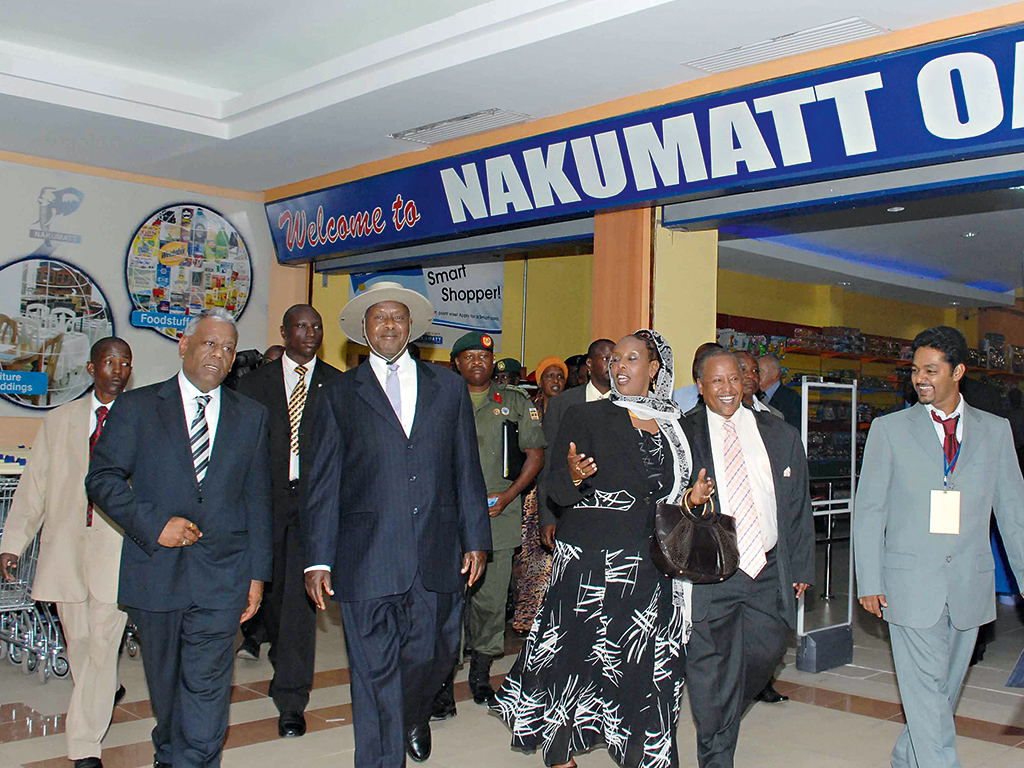
Businesswoman Amina Hersi (R) with Minister of Finance Matia Kasaija (L) during the tour of the Atiak sugar factory

According to the PWC report, as at February 1, 2015 the total loans and overdraft limits extended or available to Amina’s accounts stood at Shs 70.4bn.
“This was already 39% of the bank’s total capital of Shs 181bn as per the quarterly report of March 2015,” the report states. Despite not paying back the money, the report noted that Crane bank officials went ahead to issue more loans “to Amina’s companies and in particular facilities totaling to Shs 25.425bn on December 24, 2015.”
The report shows that Amina was associated with the bank through four entities although she is a director in two of these. “Her association with the other two companies is by way of personal guarantees,” the report said, noting that “the securities given by the two [other] companies are also properties owned by Moghe.”

Image result for Amina Hersi Moghe with Yoweri Museveni
The companies where she is a director are Khadhar Investments Limited and Horyal. The companies associated with her but where she is not a director were Minutan and Aureco.
In addition to the four companies, Amina is associated with two other companies that had accounts at Crane bank: Kingstone Enterprises Ltd and Rabo Enterprises Limited.
The report, which bears the signature of PWC partner Francis Kamulegeya, asks Bank of Uganda to carry out more investigations into Amina’s dealings in Crane bank.
SAME COLLATERAL
Ordinarily, when one applies for a loan from a bank, they present security so that in case they can’t pay, the bank can sell or take over those properties to recover the money.
PWC found that for Amina, some loans were secured using the same properties – indicating that either there was no due diligence done or that there was some collusion between bank officials and the borrower.
“The observed pattern was that additional loans and overdrafts would be sanctioned on the strength of the existing securities.
This had the effect of diluting the bank’s security position as more loans were obtained,” the report said. For example, plot 17 on William street valued at Shs 5bn and with a forced sale value of Shs 3bn was used as the main security against all three loans extended to Aureco totaling Shs 25.4bn.
The report adds that some loans were advanced on the strength of Amina’s personal guarantee that loans would be paid back.
“We, however, did not see any evidence of the bank carrying out a due diligence to establish the true net worth of Amina and especially, one where they take into account the other liabilities she is likely to have,” the report said.
COMPANIES OPENED TO RECEIVE MONEY
According to the report, one notable trend that showed that something was not right is that some of Amina’s companies that borrowed money had been incorporated days just before they applied for the loans.
One named Minutan was incorporated only six days before disbursement while Aureco had been in existence for only eight days.
“The above observation points to the possibility that the companies were formed for the sole purpose of obtaining loans. This suspicion is further supported by an analysis of the movements in these two accounts as well as the other Amina accounts that had loan exposures,” the PWC report said.
“The accounts, and especially Minutan, seem to be used to mainly pay out loaned amounts with very few material credits observed apart from the transfers from other group accounts,” the report added.
PWC further pointed out that information may have been deliberately concealed from Bank of Uganda inspectors and Crane bank auditors as not all of Amina’s accounts were disclosed as having been associated with her.
“We noted, for instance, that the KPMG management letter for 2015 did not include Aureco as one of the companies associated with Amina. This was at a time when Aureco had borrowed Shs 24.9bn from Crane bank,” the report noted.
“There is evidence that despite the information not being disclosed by Crane Bank Limited, Crane bank officials knew which accounts belonged to Amina despite the varied shareholding and considered the accounts as such.”
The investigators extracted information from computer forensics and found that the head of credit, a one Ramachandran, had listed all of the 19 accounts associated with Amina and analysed their position as at May 17, 2016.
“The above evidence points to a scenario where companies would be formed and registered under proxy directors with the intention of concealing the true exposure to a single client or group,” the investigators concluded.
DESTINATION OF BORROWED MONEY
When the investigators analysed where the money borrowed went, they found that it was usually utilised in a short time – about three months – mainly through transfers to other companies.
For instance, Crane bank sanctioned loans worth Shs 24.9bn in the form of a demand loan ($5m) and two overdrafts – Shs 3bn and $1.5m on December 24, 2015 to Aureco.
The funds were utilised over a period of three months mainly by way of transfers to other banks through accounts belonging to 13 companies.
WHO IS AMINA?
Investigators identified Amina Hersi Moghe as a prominent businesswoman with interests in real estate, commodity trading and agriculture. They wrote that she is associated with the Oasis group of companies, Atiak Sugar and the Laburnam Apartments.
Internet searches show that she is a Kenyan entrepreneur with business interests in Uganda. Last month, the 52-year-old received from government at least Shs 64bn for her sugar factory in northern Uganda.
Last year, she appeared on a list of Kampala’s businesspeople that were seeking a government bailout. PWC concluded that “[BOU] should establish the ultimate destination of the disbursed amounts as there is evidence of elaborate layering transactions that appear to be aimed at concealing the final destination of the funds.”
Rajeev Ruparelia, son of Sudhir Ruparelia, the owner of Crane bank, told us yesterday that the report was inconclusive, indicating it does not give a fair assessment of Crane bank.