A Discernment and Apostasy watch site for African Saints.
Prove all things..(1 Thesa.5:21)
Test Spirits..(I John 4:1)
Like the Bereans, check whether things are so(Acts 17:11)
The past weeks have perhaps been among the most intense and
unsettling in Uganda in recent years. Within a remarkably short period
of time, Speaker of Parliament Anita Among – until recently one of the
country’s most powerful political figures – was politically brought down
and placed under house arrest.
Soon afterwards, former Kampala mayor and
opposition lawyer Erias Lukwago was abducted and abused with Muhoozi
Kainerugaba, President Yoweri Museveni’s son and Chief of Defence
Forces, himself posting images of the abuse on social media. Uganda’s
largest independent media house, the Nation Media Group, was taken off
the air after days of increasingly explicit threats by Muhoozi.
Veteran politician Miria Matembe was
arrested days after publicly criticizing Muhoozi and the growing wave of
abductions. Senior journalist Timothy Kaligyera was also abducted over
the past days. Particularly striking throughout these events was that
Muhoozi himself publicly announced, ordered or endorsed many of them
through his social media accounts.
Taken together, they suggest something more than another episode in the increasing use of force in this ‘late Museveni era’.
The removal of Among showed Muhoozi’s ability to neutralise one of the
country’s most powerful political figures, as well as to decide on the
next speaker of Parliament. The events that followed suggested that he
was equally willing to exercise that power more directly, with little
regard for formal state institutions. Has Muhoozi effectively taken
control?
A looming crisis
In order to answer that question, let’s first focus on the context that allowed these events to happen. Earlier this year, I argued in the Journal of Democracy that Uganda
was heading towards a looming political crisis. Over almost four
decades in power, President Museveni has gone to great lengths to
personalise the state around himself. In the last 10 years, this
concentration of power has only deepened, with political decision-making
increasingly confined to an ever-narrower circle in which the first
family occupies a central place.
As Museveni, now 82, has grown older,
maintaining this highly personalised system has become more difficult,
however. This means that important decisions have become increasingly
delegated to trusted insiders, above all Salim Saleh, who today runs
what amounts to a shadow cabinet, but also to Muhoozi.
Muhoozi’s position changed fundamentally
after he became Chief of Defence Forces in 2024. Before then, his
authority still encountered resistance, and on occasion he could be
forced to retreat, as happened after his 2022 tweets threatening to invade Nairobi.
Since becoming CDF, that has no longer been the case. Through a
combination of promotions, reshuffles and anti-corruption campaigns
within the army – some no doubt genuine, others equally useful
politically – he steadily consolidated his hold over the military.
Senior officers associated with the old
guard were pushed into retirement. During the same period, Muhoozi also
became increasingly explicit about his ambition to succeed his father,
something he first openly did in 2023.
Muhoozi did not stand in the January elections, but his presence loomed over them.
Much attention focused on the positions that members of his political
vehicle, the Patriotic League Uganda (PLU), would obtain. The PLU is not
a political party, and alternates between presenting itself as a
vehicle for renewing the NRM and distancing itself from it – but in both
cases presenting itself as an autonomous political organisation centred
on Muhoozi.
Even before the parliamentary and
presidential elections, several outspoken PLU supporters had already
secured influential roles in key party bodies, including the Central
Executive Committee, leading many to expect that the post-election
cabinet would clearly reflect Muhoozi’s – and PLU’s – growing influence.
The eventual cabinet appointments,
however, came as something of an anti-climax. There were fewer Muhoozi
or PLU figures than expected, while close Museveni allies and figures
associated with Salim Saleh – the other major centre of power within the
Ugandan state – retained important positions. This suggested that
Muhoozi’s takeover would be slower than many had anticipated, and that
both Museveni and Saleh still exercised considerable influence over the
government.
The fall of Anita Among and power without institutions
That impression has since been overtaken
by events. The government itself has become increasingly less relevant,
as Muhoozi has shown little hesitation in exercising power directly. The
political neutralisation of former Speaker of Parliament Anita Among
marked an important turning point.
Among had established herself as one of
Uganda’s most influential political figures, building an extensive
network of influence throughout and beyond the state, one that also
rested heavily on corruption (something that was exposed in 2024 during
Agora’s online campaign on corruption in parliament).
During the election campaign, she
campaigned vigorously for President Museveni and was widely expected to
retain her position. In the weeks before the cabinet appointments,
however, Muhoozi and his allies increasingly turned against her,
sometimes in cryptic terms and sometimes quite openly.
Particular attention centred on reports
that she had acquired a Rolls-Royce, prompting Muhoozi to tweet: “I have
been Mzee’s son for 52 years but I have never sat in a Rolls-Royce ever.
I don’t think Mzee has sat in one either.” In another post, he wrote:
“Our job is to serve Ugandans, not ourselves. I cannot support
corruption. I risked my life to make this country peaceful. Now that it
is, it will not be taken by thieves. Never!” On 12 May, PLU publicly
withdrew its earlier support and endorsement for Among. Soon afterwards,
her residences were raided and searched, her vehicle fleet was
impounded, and she has remained under house arrest.
Within Uganda, this was widely perceived as being about control and power, rather than about corruption. Tensions between Among and Muhoozi had existed for some time, with Muhoozi increasingly viewing her as a political rival.
Her subsequent public deference to both Museveni and Muhoozi – including praising them as the Father, Son and Holy Spirit
– only underlined how thoroughly she had been politically subdued; but
that didn’t help her: she had become too much of a threat.
The whole episode sent a clear message:
Muhoozi has the power to go after whomever he wants, in whichever way he
wants. Anyone could be a target. At the same time, it showed clearly:
the government or parliament doesn’t seem to matter any more. What
matters is Muhoozi and PLU.
An escalating trend
The trend only intensified in the weeks
that followed. Over the past years, abductions had become an almost
established feature of Uganda’s political landscape, but they largely
targeted supporters of opposition leader Bobi Wine’s National Unity
Platform (NUP) and civil society figures, especially during and after
the election campaign. However cynical it might sound, it did allow many
– locally and internationally – to ignore what was happening.
In recent weeks, however, both the number
and profile of those targeted have changed, extending well beyond the
opposition. The fact that these incidents have occurred in rapid
succession, outside election periods or large-scale protests, has
reinforced the sense that almost anyone could become a target at any
time.
First, there was the abduction and abuse of former Kampala mayor and opposition lawyer Erias Lukwago. Images of a blindfolded Lukwago, his head freshly shaven,
accompanied by triumphant social media posts from Muhoozi, sent
shockwaves through the country. The detention of veteran politician and
human rights advocate Miria Matembe carried an even more powerful
message.
Matembe, a long-time political figure who
was once a close ally of President Museveni, had publicly criticised the
growing wave of abductions and Muhoozi’s expanding political role.
After security personnel raided her home on 24 June, she was detained
four days later. The images of the 72-year-old Matembe,
limping into court while relatives and supporters wept openly, captured
the sense of fear that these arrests have generated. There was also the
deportation of Kenyan senior politician Martha Karua, who was acting as
a counsel for Kiiza Besigye – a deportation Muhoozi claimed to have ordered.
Then there was the closure of the Nation
Media Group, following days of increasingly explicit threats by Muhoozi.
The shutdown took the Daily Monitor, NTV, KFM, Dembe FM and Spark TV
off the air. As the country’s largest independent media house, its
closure deprived Uganda of its most influential independent news
platform and marked a major escalation in the shrinking space for free
media.
Here too, Muhoozi was explicit that he ordered the closure
of the media house – with consent from his father – stating he doesn’t
believe in a free press. In other words, it was Muhoozi who ordered it,
rather than the Uganda Communications Commission or any other formal
regulatory authority. It took the government two and a half days to come
up with a – vague – statement.
Is Uganda experiencing a slow coup?
One question that is on many people’s
minds is whether the country is witnessing a coup. As such, this
question isn’t really new: the control of the army has been increasing
rapidly since Muhoozi took charge; and particularly since the adoption
of the new UPDF Bill in June 2025, which gives far-reaching powers to
the army.
One Ugandan research report called this
“a coup by other means” or “a coup in slow motion”. The events of the
past weeks have given concrete form to that argument – one commentator
captured this emerging political order by describing it as “a military junta with a PR team“.
The removal of Anita Among, and
appointment of the new Speaker of Parliament, already showed that key
political decisions were no longer being taken through the formal
institutions of government. The weeks that followed strengthened that
impression.
Muhoozi directed the closure of the country’s largest independent media house, intervened in decisions concerning the Kampala Capital City Council,
and openly announced or endorsed arrests and detentions. In many of
these cases, legal justification followed only afterwards, if it came at
all.
The installation of the new Secretary General of the Patriotic League Uganda (PLU) offered another illustration. It brought together
a remarkable cross-section of Uganda’s political establishment,
including the Speaker of Parliament, ministers and numerous MPs,
underscoring where many political actors now see the country’s centre of
power. At the same time, the question of whether Uganda is already living under “President Muhoozi” has moved well beyond social media and now features prominently in political debate.
Silence
Perhaps as striking as the events
themselves has been the silence surrounding them. President Museveni has
remained largely absent, while neither the government nor the courts
have meaningfully challenged what has been taking place. Political
authority appears increasingly concentrated around Muhoozi, while the
institutions that would ordinarily provide checks have remained
remarkably quiet.
The same silence extends well beyond the
state. Uganda’s media had already operated for years under growing
pressure and increasing self-censorship, making independent reporting
ever more difficult. The closure of the Nation Media Group has only
reinforced that trend. Foreign journalists have largely left the
country.
There has also been no reaction to the
recent events by any of the major donors – whether one looks at the EU,
US or UK. (As for the US, there was only a tweet by the US Foreign Affairs Committee Chair on social media.)
Religious leaders have largely been incorporated into the system through years of patronage, while the political opposition has largely been neutralized or fragmented. Bobi Wine had to flee the country, and many other opposition figures have faced arrest or intimidation.
Fear therefore has become an equally
important part of the picture. The concern is no longer limited to
political activists or opposition supporters, but increasingly centres
on who may be targeted next. Within public and private debates, there’s
an increasing concern of “saying something wrong”; and there are
increasing concerns of surveillance and tapped phones – reinforced by
the circulation of leaked private phone conversations, including those involving Uganda’s EU ambassador and Minister Kahinda Otafiire.
This marks a profound change from the open
and often vibrant political debate that long characterised Uganda.
Diplomats have likewise remained cautious, given the increasingly
hostile rhetoric directed at several ambassadors over the past years.
Against that backdrop, public criticism
has become increasingly rare. Over the past week, the most notable
intervention came from longtime NRM stalwart and former government
spokesperson Ofwono Opondo, who openly questioned the country’s current
trajectory. Careful criticism has also come from Prince Kassim Nakibinge, the titular head of Uganda’s Kibuli Muslim community and a prominent Buganda royal.
Social media—particularly X—remains one of
the few spaces where political debate continues and civil society
voices can still be heard. Yet the arrest of prominent X user Timothy
Kaligyera under the Computer Misuse Act, together with the police
interrogation of Agora activists, sends a clear warning about the risks
of speaking out.
The first family
Perhaps the most striking reactions have
come from within the First Family itself. In the past week, Museveni’s
son-in-law Odrek Rwabwogo released a video
saying he was “extremely worried to the core about the direction the
country is taking” and calling on Ugandans to unite and speak out.
Perhaps most remarkably, he argued that
President Museveni must be protected “from wrong unthinking characters
who are undermining the greater good (…) no one group should seek to
monopolize him or to pretend to act on his behalf”.
This latter statement was widely perceived
as a clear reference to the influence of Muhoozi and PLU. There has
been a longstanding feud between Muhoozi and Odrek: Muhoozi, for example, called him
‘the biggest thief in Uganda’ on X in 2024. The video seemed like a
last-ditch attempt of Odrek – a long-time competitor of Muhoozi for the
Presidency – to gather political support, and potentially temper
Muhoozi.
Around the same time, Natasha Museveni
– who is very much her father’s “right-hand woman” – released an
emotional video describing Uganda as “going through a difficult period”
and urging people “not to lose hope or become overwhelmed by events”.
While her remarks have to be understood in
the context of the prolonged illness of Janet Museveni, their timing
remains striking, in the current shift of power. A letter attributed to Salim Saleh also surfaced, in which he appeared to offer advice and restraint to Muhoozi in relation to the Lukwago affair.
These developments suggest a number of
things within the first family: concern, a loss of control over the
current events, as well as the difficulty that those around Muhoozi
appear to have in influencing him.
They also point to the further retreat of
President Museveni. His increasingly limited public role has become more
apparent over recent months, a process that appears to have accelerated
with Janet Museveni’s illness. She was last seen in public of March of this year, and it was recently acknowledged that she survived a major health scare.
Speculation about the President’s health
has also intensified, reinforced by comments from Muhoozi ally and
regime insider Andrew Mwenda, who recently described Museveni as “old and exhausted, both intellectually and physically“,
with only a limited ability to oversee the affairs of government.
Whether or not that assessment is accurate, the perception of a
President who is increasingly absent has become an important part of the
current political dynamics.
Who governs Uganda?
The broader question is whether President
Museveni still controls the political system he spent four decades
building. Recent events suggest that the personalized decision-making
structure has increasingly spiraled out of his hands, with Muhoozi
playing a central role – extending his influence over both the UPDF and
the NRM at great speed.
The language increasingly used by his
supporters reflects that confidence. When NRM stalwart Ofwono Opondo
asked whether “the NRM that Ugandans elected on 15 January 2026 is no
more”, the Executive Secretary of the Patriotic League Uganda confidently replied that this indeed was the case. While the message was later deleted, it offered a revealing glimpse into how parts of the PLU now view the political landscape: they are the ones in charge.
The same pattern has become visible
elsewhere. Following the closure of the Nation Media Group, it was not
the responsible ministry or regulatory authority that announced
negotiations over its possible reopening, but Andrew Mwenda, one of Muhoozi’s closest political allies and a leading figure within the PLU.
How far this process will go remains
uncertain. Within broader society and political circles, there’s much
concern about who, or which institution will be next, and how far this
process will go. The concentration of power, the willingness to use it,
and the brazenness of it all point to concerning and troubling times
ahead.
Kristof Titeca is Professor at the Institute of Development
Policy (IOB) at the University of Antwerp, and a Senior Associate Fellow
at the Egmont Institute (Brussels).
Lead Counsel for Dr. Kizza Besigye and Haji Obeid Lutale in the High Court of Uganda Treason Trial
The New York City Bar Association is deeply concerned about credible
allegations of arbitrary arrest, abduction, and unlawful detention
amounting to conduct consistent with an enforced disappearance, directed
against Mr. Erias Lukwago, a prominent human rights attorney currently
representing leading members of the Ugandan political opposition. Mr.
Lukwago was detained by the Special Forces Command of the Ugandan
Peoples’ Defense Forces (UPDF). Mr. Lukwago’s abduction constitutes yet
another example of the continuing intimidation of lawyers and judges in
Uganda and has broader negative implications for the rule of law in
Uganda.
On June 15, 2026, members of the Special Forces Command of the UPDF
forced themselves into Mr. Lukwago’s private residence in the Wakaliga
neighborhood of the Lubaga Division of Kampala, detained him, and
removed him to an undisclosed location. These soldiers were acting at
the direction of General Muhoozi Kainerugaba, Chief of the Defense
Forces of the UPDF and son of Uganda’s President Yoweri Museveni.[1]
According to the affidavit of Mr. Lukwago’s wife, the operatives
failed to present an arrest warrant, identify themselves, or communicate
any offense for which Mr. Lukwago was being arrested.[2]
Mr. Lukwago is currently serving as lead counsel to Dr. Kizza Besigye
and Haji Obeid Lutale, in their ongoing treason trial in the High Court
of Uganda – a trial that is widely considered to be politically
motivated.[3]
According to Dr. Besigye, a prominent opposition figure and former
presidential candidate, Ugandan officials extrajudicially abducted him
from Nairobi, Kenya in late 2024, and transported him to Uganda to
illegally face a military tribunal.
Mr. Lukwago also represents Dr. Besigye in another related case,
concerning multiple death threats against Dr. Besigye made by General
Kainerugaba on social media platforms.[4]
In connection with this matter, Mr. Lukwago was preparing to serve a
court summons on General Kainerugaba. The same day that Mr. Lukwago was
detained, General Kainerugaba publicly stated on the social media
platform X that he would arrest anyone attempting to serve him with
court papers and posted that he had ‘captured a fool and taken him to
the basement.’[5]
General Kainerugaba then posted images of Mr. Lukwago blindfolded and
in an undisclosed location and boasted that he was ‘proud of all of the
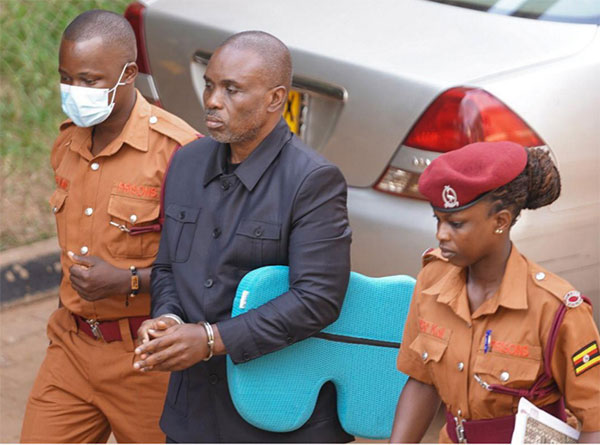
hurt and pain’ he would inflict on Mr. Lukwago.[6] Mr. Lukwago has since been charged with misprision of treason (failure to report treason), and has been remanded in custody.[7]
The UPDF’s unlawful treatment of Mr. Lukwago constitutes blatant
retaliation for him carrying out his professional responsibilities and
duties and contravenes national laws as well as Uganda’s obligations
under regional and international legal frameworks.
The arbitrary arrest, abduction, unlawful detention, and credible allegations of ill-treatment of Mr. Lukwago[8] highlight a worrying trend and democratic decline in Uganda,[9]
with increased military interference in civilian affairs, carried out
with impunity. Mr. Lukwago’s family and legal team have reported that he
was beaten during transport to an undisclosed location and held
incommunicado. There are also serious concerns regarding Mr. Lukwago’s
health: lawyers appearing on his behalf have reported worsening spinal
complications, a weakened immune system, and exposure to tuberculosis[10] at Murchison Bay Prison, where he is being held.[11]
Moreover, the detention of counsel – here, Mr. Lukwago – during active
proceedings interferes with the rights of the accused and may amount to
an obstruction of justice. This is not merely an individual rights
violation; it is an institutional crisis affecting the rule of law and
the administration of justice in Uganda.
Of particular concern is the very nature of the charge against Mr.
Lukwago. The misprision of treason charge alleges that Mr. Lukwago
failed to report information he allegedly obtained in the course of his
professional duties as defense counsel. His legal team has explained
that such information is protected by lawyer-client privilege and that
criminalizing lawyer-client communications fundamentally undermines the
right to legal representation and the fairness of criminal proceedings.
The Uganda Law Society has described Mr. Lukwago’s prosecution as a
gross abuse of process, underscoring that serving court documents or
vigorously defending a client in a high-profile political trial does
not, and cannot, constitute misprision of treason. The New York City Bar
Association strongly concurs: the charging of defense counsel on the
basis of information obtained in the course of their professional duties
constitutes a direct attack on the attorney-client relationship and on
the constitutional right of every accused person to effective legal
representation.
In June 2025, the Uganda Peoples’ Defense Forces (Amendment) Act was
signed into force, with provisions allowing civilians to be tried in
military courts. This followed and was apparently intended to counter
the previous striking down by the Uganda Supreme Court of a similar law
under which civilians were being subjected to military criminal
jurisdiction.[12]
The military has consistently obstructed lawyers from adequately
representing clients subjected to military trials in Uganda, including
prior counsel to Dr. Kizza Besigye, Mr. Eron Kiiza, who was charged with
and convicted of contempt of court in a military court and sentenced to
nine months’ imprisonment.
Mr. Lukwago’s case has drawn widespread condemnation from the legal community and civil society. The East African Law Society[13] has denounced his arrest as unlawful and inhumane.[14]
The Uganda Law Society and the Law Society of Kenya have strongly
decried the arrest and prosecution, describing it as an attack on the
legal profession and the administration of justice and warning of a
chilling effect on lawyers representing clients in politically sensitive
cases. The Commonwealth Lawyers Association similarly condemned the
detention, stating that targeting defense lawyers through arrest because
of their work for a client strikes at the heart of judicial
independence and the right to a fair trial.[15]
The Uganda Law Society President wrote directly to the Director of
Public Prosecutions, copied to the Chief Justice and the Attorney
General, demanding the immediate and unconditional withdrawal of all
charges.
The Council of Bars and Law Societies of Europe – representing more
than one million lawyers across 46 countries – wrote directly to
President Museveni on June 24, 2026, calling on Ugandan authorities to
clarify the legal basis for Mr. Lukwago’s detention, ensure his ability
to continue his legal work without obstruction, and uphold the United
Nations Basic Principles on the Role of Lawyers.[16] In a further escalation, the Uganda Law Society declared a nationwide lawyers’ strike on June 26, 2026[17]
– World Anti-Torture Day – after issuing a 24-hour ultimatum to the
authorities demanding Mr. Lukwago’s immediate release. The case – and
the wider crackdown of which it forms part – has been widely covered in
regional and international media as emblematic of a deepening and
accelerating assault on the rule of law, the independence of the legal
profession, and freedom of expression in Uganda.[18]
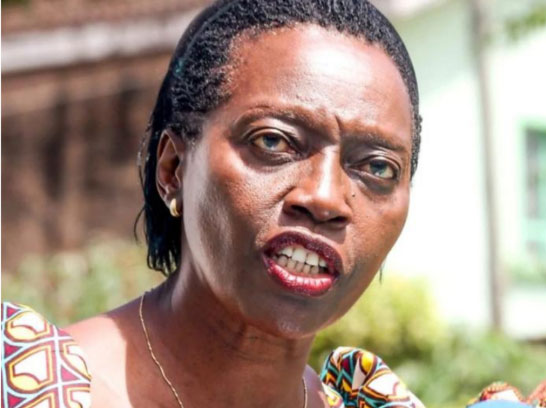
On June 22, 2026, Hon. Martha Karua, SC – Mr. Lukwago’s co-lead
counsel and former Kenyan Cabinet Minister for Justice and
Constitutional Affairs – was detained and deported from Entebbe
International Airport upon her arrival in Uganda to attend court
proceedings in Mr. Lukwago’s case.[19]
Uganda declared her persona non grata, a development that has been
widely denounced as a further and egregious interference with the right
to counsel[20] and the administration of justice.[21]
On June 23, 2026, Chief Magistrate Sarah Anne Basemera denied bail to Mr. Lukwago in an electronic ruling,[22]
finding that the ongoing nature of the investigations, together with
Mr. Lukwago’s acknowledged public influence and the circumstances of the
case, weighed against his release at this stage of the proceedings.[23]
The court nevertheless ordered the Officer in Charge of Murchison Bay
Prison and the Commissioner General of Prisons to facilitate Mr.
Lukwago’s referral to Mulago National Referral Hospital within 24 hours
for a comprehensive medical assessment and treatment.[24]
Mr. Lukwago was expected to be produced in court on June 30, 2026, but
the proceedings were adjourned to July 7, 2026, because he is undergoing
specialized medical investigations and treatment.[25]
The crackdown has since widened dramatically beyond the legal
profession. On the night of June 28, 2026, General Kainerugaba ordered
the forced closure of at least six major media outlets,[26]
including the Daily Monitor newspaper, NTV, Spark TV, Dembe FM, KFM,
and The East African – all part of the Nation Media Group – with
soldiers deployed to their Kampala premises. General Kainerugaba
declared on X: ‘I have the power in Uganda to shut down ANY media house I
want to. From now on ALL media in Uganda will follow the rules.’ No
legal basis, formal instrument, or gazette notice was cited for the
closures. The National Association of Broadcasters described the
shutdowns as a serious blow to Uganda’s media ecosystem.[27]
Amnesty International called the closures emblematic of ‘an unchecked
and unjust campaign of harassment and intimidation of independent media
and civil society.’
The Chairman of the United States Senate Foreign Relations Committee
called on the U.S. to review its security relationship with Uganda,
stating that General Kainerugaba’s attacks on freedom of expression,
including the forced closure of major media outlets, make him and the
UPDF ‘unfit partners’ for the United States.[28]
In parallel, on June 24, security forces raided the home of Dr. Miria
Matembe, a former Minister of Ethics and Integrity and one of the
architects of Uganda’s 1995 Constitution, who had publicly criticized
General Kainerugaba’s human rights record.[29]
After spending two days in hiding, Dr. Matembe was arrested on June 28.
General Kainerugaba personally confirmed her detention on X. The Uganda
Law Society formally wrote to the Inspector General of Police seeking
clarification of Dr. Matembe’s whereabouts and legal status.[30]
On the same day, two civil society lawyers – Dr. Sarah Bireete,
Executive Director of the Centre for Constitutional Governance, and
Eunice Musiime, Executive Director of the Alliance for Women Advocating
for Change – were also arrested at Musiime’s residence and held for
questioning before being released.[31]
In a further legal escalation, forty lawyers from twelve law firms
filed a human rights enforcement action in the High Court of Uganda on
June 29, 2026, directly challenging General Kainerugaba’s conduct –
including the abduction of Mr. Lukwago and the deportation of Hon. Karua
– as unconstitutional violations of the right to counsel and the fair
administration of justice.
Articles 23 and 24 of the Constitution of Uganda protect the right to
personal liberty, establish conditions for lawful arrest and detention,
and prohibit torture and inhuman and degrading treatment by state
actors and others. Uganda’s Prevention and Prohibition of Torture Act
criminalizes torture and ill-treatment by state actors and others, while
the Criminal Procedure Code Act regulates powers and procedures for
arrest and detention. Uganda’s Constitution, its Advocates Act, and its
Prevention and Prohibition of Torture Act collectively protect the right
to personal liberty, set conditions for lawful arrest and detention,
safeguard the professional independence of lawyers, and criminalize
torture and ill-treatment by state actors or others. In particular,
under Article 208(2) of the Constitution, the UPDF is subordinate to
civilian authority and cannot intimidate, threaten, or arrest lawyers
performing their professional duties. Detaining defense counsel during a
trial also contravenes the constitutionally protected right of the
accused to a fair trial.
Uganda’s actions in this case similarly contravene its
responsibilities under regional frameworks and international law.
Regionally, the Principles and Guidelines on the Right to a Fair Trial
and Legal Assistance in Africa mandate the protection and independence
of legal professionals such as Mr. Lukwago, while the African Charter on
Human and Peoples’ Rights (ACHPR) guarantees personal liberty and
security, and prohibits arbitrary arrest and detention. Internationally,
Uganda is bound by legal obligations such as the International Covenant
on Civil and Political Rights (ICCPR), which prohibits arbitrary
arrest, detention, and violations of fair trial standards; the
Convention Against Torture and Other Cruel, Inhuman or Degrading
Treatment or Punishment (CAT), which obligates the prevention and
punishment of torture; and the United Nations Basic Principles on the
Role of Lawyers, which protect lawyers from harassment, interference,
and intimidation, and emphasize that lawyers must be free to represent
their clients without fear of reprisals.
The New York City Bar has previously expressed grave concern about
the obstruction of lawyers through military impunity in Uganda, after
the conviction of Mr. Eron Kiiza, calling on the government of Uganda to
uphold its international human rights obligations and to refrain from
targeting lawyers carrying out their duties as representatives.[32]
The New York City Bar Association calls on the Ugandan authorities to:
Respect the due process rights of Mr. Erias Lukwago, secure his
immediate release, and guarantee his safety and well-being – including
access to appropriate medical care – and the safety and well-being of
his family members.
Immediately and unconditionally withdraw the misprision of treason
charge against Mr. Lukwago, which criminalizes the exercise of his
professional duties as defense counsel and is incompatible with the
right to legal representation and the principle of lawyer-client
privilege.
Uphold the rule of law by guaranteeing that legal professionals can
perform their duties without fear of harassment, intimidation, or
unlawful detention.
Conduct a thorough and impartial investigation into the abduction
and unlawful detention of Mr. Lukwago, including credible allegations of
ill-treatment, and ensure that his rights are fully protected.
Immediately reverse the declaration of Hon. Martha Karua, SC as
persona non grata and allow her to return to Uganda to fulfill her
professional obligations as co-lead counsel, and ensure that Mr.
Lukwago, Hon. Karua, and other members of their legal team are not
threatened, targeted, or impeded in their representation of Dr. Besigye
and Haji Lutale.
Ensure that all allegations of abduction, unlawful detention, and
extrajudicial transfer are subject to thorough and impartial
investigation, and that the rights of all persons deprived of their
liberty are fully protected.
Immediately release Dr. Miria Matembe and all other individuals
arbitrarily arrested in connection with the current crackdown, and
ensure that civil society leaders and human rights defenders are free to
carry out their work without fear of reprisal.
Immediately reopen all media outlets closed on June 28, 2026, and
refrain from any further interference with freedom of the press and
freedom of expression.
Engage and cooperate fully with relevant international and regional
human rights mechanisms, including the UN Special Rapporteur on the
Independence of Judges and Lawyers, the UN Special Rapporteur on
Torture, and the African Commission on Human and Peoples’ Rights, in
light of the reported targeting of Mr. Lukwago while carrying out his
professional duties as defense counsel and the credible allegations of
ill-treatment during his detention, with a view to ensuring independent
monitoring, accountability, and protection of the rule of law.
Uphold international and constitutional obligations to respect,
protect, and promote the rights of all citizens, including legal
professionals and human rights defenders.
Legal practitioners play a unique and vital role in society. In
recognition of this important function, they are accorded special
protection under national, regional, and international law. These
rights, and the independence of the judiciary, are cornerstones of a
just society and must be defended. The New York City Bar Association
strongly condemns the illegal arrest, abduction, and detention of Mr.
Lukwago and stands in solidarity with Ugandan lawyers and human rights
defenders advocating for justice and the rule of law.
A wave of opposition arrests, military detentions and treason charges signals a deepening political crisis
COVER STORY | IAN KATUSIIME | Uganda’s security
agencies’ continued abduction and torture of political opponents, with
Erias Lukwago, former Kampala Lord Mayor and lawyer to the incarcerated
Dr Kizza Besigye on treason charges, becoming the latest political
figure linked to these developments, has heightened anxiety and fear
across the country, reviving memories of the dark days of former
President Idi Amin and fuelling concerns among critics over what they
describe as a weakening of the rule of law.
Lukwago, also the president of the People’s Front for Freedom (PFF),
the country’s newest political party, was abducted by soldiers attached
to the Special Forces Command (SFC) from his home in Wakaliga, on the
outskirts of Kampala, on the morning of June 15 as he set out to serve a
summons on Gen. Muhoozi Kainerugaba, the Chief of Defence Forces and
son of President Yoweri Museveni, who has ruled Uganda for 40 years.
The operation, allegedly carried out on Muhoozi’s orders, saw Lukwago
bundled into a drone van, an incident that sparked concern over his
safety and possible prolonged detention.
Dr Besigye had, on June 8, filed a lawsuit against Muhoozi over
alleged unlawful detention and public threats to his life. Filed in the
High Court in Kampala, the suit alleges that Muhoozi’s statements,
including threats to hang Besigye on Heroes’ Day, violated his
constitutional rights.
High Court Judge Arthur Baguma granted Muhoozi seven days to respond
to the suit. Although Muhoozi had earlier declared on X that “Only Mzee
(my father) can summon me”, The Independent understands that he
has since responded to the court summons, seeking the dismissal of an
application filed by veteran opposition politician Dr Kizza Besigye.
In an affidavit sworn by Lt Col. Daniel Atwine, head of the Special
Investigations Bureau of the UPDF, the state dismisses the allegations
made by Dr Besigye and co-applicant Obed Lutale as “misconceived,
speculative, founded on hearsay and conjecture”, arguing that the claims
should be addressed during the criminal trial rather than through a
separate court application.
Meanwhile, Lukwago, who appeared in court on Monday for the mention
of his case after being charged with misprision of treason and remanded
to Luzira Prison, was denied bail.
The proceedings took place amid controversy after immigration
officials blocked Dr Besigye’s lead lawyer, Martha Karua, a Kenyan
national, from entering the country to observe the proceedings.
Uganda’s Constitution bars serving members of the Uganda Peoples’
Defence Forces (UPDF) from engaging in partisan politics or making
political statements. However, the CDF has repeatedly made political
pronouncements and vowed to arrest those who criticise or oppose him.
Lukwago’s abduction was met with widespread outrage and condemnation
from members of the public concerned about the deteriorating human
rights situation in the country. On social media, many Ugandans demanded
his immediate release.
Lukwago has, over the years, earned a reputation as a champion of
ordinary Ugandans, both as Kampala Lord Mayor and as a constitutional
lawyer committed to defending the rule of law.
Martha Karua, Besigye’s lead lawyer was barred entry into Uganda at Entebbe International Airport.
He has also represented numerous opposition politicians in both civil
and criminal cases. In a statement, the East Africa Law Society urged
the Ugandan judiciary to uphold Lukwago’s rights.
“Ensure that his application for bail is determined fairly,
expeditiously and in accordance with the law,” said EALS President
Ramadhan Abubakar.
Following his abduction, Lukwago was reportedly taken to a facility
in Kasenyi, Entebbe, where Muhoozi later posted a photograph of the
former Kampala mayor in visible distress, his head shaved.
He was only presented before Makindye Chief Magistrate’s Court more
than 48 hours after his arrest, well beyond the stipulated timeframe for
presenting a suspect in court under the country’s laws.
The incident echoed the treatment of Eddie Mutwe, bodyguard to
opposition leader Bobi Wine, who underwent a similar ordeal after being
abducted on Muhoozi’s orders in May last year. Mutwe remains in prison.
Lukwago’s wife told journalists that his husband was slapped, beaten,
stripped naked, and photographed in an apparent attempt to humiliate
him.
His court appearance on June 19 drew a large crowd of supporters and
well-wishers before he was taken to prison. Through his lawyer, Medard
Ssegona, Lukwago told the court that he suffers from hypertension,
gastritis, respiratory complications, and a spinal injury that requires
specialised treatment.
Lukwago’s ordeal joins that of his long-time political ally, Dr Kizza
Besigye, who has been in detention since November 2024. Besigye,
alongside his comrade Obed Lutale, was abducted in Nairobi, Kenya, in
what critics describe as a joint operation involving Ugandan and Kenyan
security operatives before being driven to Uganda under the cover of
darkness.
The duo has since filed a constitutional petition in the High Court
of Kenya, accusing Kenyan authorities of colluding with Ugandan security
forces to abduct and unlawfully extradite them to Kampala.
Political Prisoners
Ugandan prisons and military detention facilities are believed to
hold thousands of political prisoners, some detained as far back as
2019, when the People Power Movement emerged as a formidable force in
opposition politics.
Just months after Uganda’s most recent elections, a growing wave of militarisation appears to have engulfed the country.
Social media platforms have been flooded with calls and hashtags
demanding the release of political detainees, including Lukwago,
Besigye, Olivia Lutaaya, Bobi Giant, Achileo Kivumbi, Mutwe and many
others.
To make the situation worse, many remain unaccounted for. For
instance, one of the most prominent cases is that of George Kibalama,
who was allegedly disappeared by state agents on Martyrs Day, June 3,
2019. Kibalama’s wife died a few months ago, leaving behind three young
children who continue to live without answers regarding their father’s
whereabouts.
Robert Kyagulanyi, popularly known as Bobi Wine and president of the
National Unity Platform (NUP), sneaked out of the country with his
family for the United States after the military laid siege to his home
in Magere, Wakiso District, during a nationwide manhunt. At the time,
Muhoozi declared that he was searching for Bobi Wine “dead or alive”.
Bobi Wine has remained one of Muhoozi’s most vocal critics on social
media, particularly on Twitter, a platform beyond the military chief’s
direct control.
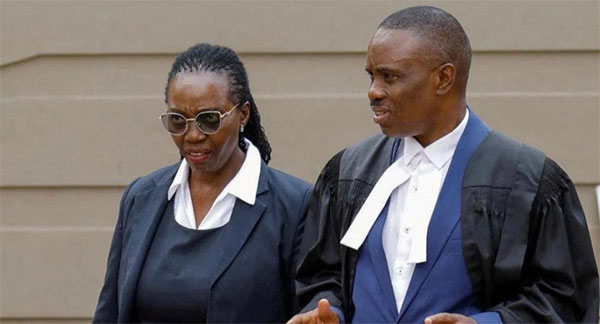
Martha Karua and Erias Lukwago made up Besigye’s legal team.
At the same time, Muhoozi has frequently used the platform to issue
threats against opponents and make controversial remarks. On one
occasion, he claimed to be disappointed that security forces had killed
“only 22” NUP members, a statement that drew widespread condemnation.
Bobi Wine’s wife, Barbie Kyagulanyi, revealed that she was tortured
by SFC soldiers who raided her home while searching for her husband.
Muhoozi has also said that Leader of Opposition Joel Ssenyonyi is
next in line for his basement. Ssenyonyi has remained steadfast in his
criticism of the CDF over the years.
Following Lukwago’s abduction, Ssenyonyi held a press conference at Parliament and urged Muhoozi to formally join politics.
“Remove the uniform and stop using your office to play politics,” he
said. Ssenyonyi later tweeted about an alleged plot to implicate him in
the treason case facing former Butambala MP Muwanga Kivumbi.
Muwanga was arrested in January this year and charged with treason
following a scuffle in Butambala District during which police shot and
killed some of his supporters under circumstances that remain unclear.
The CDF has also instructed his Patriotic League of Uganda (PLU) to
field a candidate for Leader of Opposition, another move critics say is a
blatant violation of the law.
Had any other Chief of Defence Forces attempted to establish a
political movement while still in active service, they would likely have
faced arrest and court martial proceedings, as happened to senior
military officers such as Lt. Gen. Henry Tumukunde, Col. Kizza Besigye,
Gen. David Sejusa and others. Their offence was challenging President
Museveni in his capacity as Commander-in-Chief.
Kahinda Otafiire, an NRA historical and current Minister of Water and
Environment, has emerged as one of the few voices within Museveni’s
inner circle willing to openly criticise Muhoozi.
Speaking at a recent meeting following Lukwago’s abduction, Otafiire,
in his trademark blunt and unapologetic style, warned against remaining
silent.
“You see what is happening today. Do not commit the sin of silence,”
said Otafiire, whose political journey began more than five decades ago
when he joined the Front for National Salvation (FRONASA), the movement
founded by Museveni to fight Idi Amin.
As abductions, torture and killings increasingly become part of the
national conversation, many Ugandans have expressed shock and concern
that the country appears to be drifting back toward the dark days of
military dictatorship. Amin ruled Uganda for eight years in a reign
marked by widespread fear and brutality before being overthrown in 1979
by Tanzanian forces and Ugandan exiles after he attempted to annex
Tanzania’s Kagera Salient.
Treason charge
The treason charge has increasingly become the state’s preferred tool
against political opponents. Ironically, critics argue that individuals
who have made statements that could be construed as treasonous have
continued to walk free.
One such case involves businessman Frank Gashumba, who portrays
himself as a leader of the Abavandimwe (Banyarwanda) community. In a
widely circulated video, Gashumba suggested he would mobilise the M23
militia in Uganda to respond to what he described as persecution of
their community.
Critics contend that Gashumba should have faced legal scrutiny for
publicly expressing solidarity with a rebel group accused
internationally of committing atrocities, including mass killings and
crimes against humanity in the eastern Democratic Republic of Congo.
Instead, Gashumba continues to enjoy state-provided security escorts.
Muhoozi responded to the controversy by saying he would simply hold a
meeting with Gashumba to “resolve the matter”.
Besigye and Lukwago, by contrast, face treason-related charges based
on allegations their supporters describe as unsubstantiated. Their
detention in Luzira Prison has galvanised many Ugandans including the
church, demanding justice, accountability and greater respect for the
rule of law.
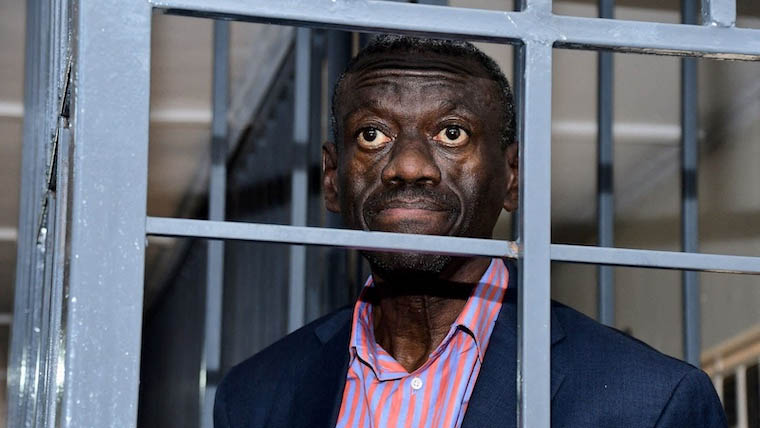
Dr Besigye has been in jail since Nov 2024.
Besigye’s health has deteriorated significantly during his detention.
Lukwago, meanwhile, enters prison with pre-existing medical conditions
that have already raised concerns among his supporters and legal team.
From the moment a visibly frail Besigye was wheeled into Nakawa Chief
Magistrate’s Court and charged with treason and misprision of treason
without the knowledge of his lawyers, supporters have maintained a
persistent call for justice.
Public pressure, however, has yielded some results. Besigye’s
eventual appearance before the Nakawa court came after growing outrage
sparked by images circulating on social media showing his worsening
health condition.
The proceedings also marked the effective end of the long-running
controversy surrounding the trial of civilians in military courts.
Earlier, the Supreme Court had ruled that civilians should not be tried
before military tribunals, paving the way for such cases to be
transferred to civilian courts.
Notably, the charge sheet filed before the Chief Magistrate’s Court
omitted the firearms possession charges that Besigye and his co-accused,
Obeid Lutale, had previously faced before the General Court Martial.
The fates of Besigye and Lukwago—two men who have worked closely together for more than a decade—have now become intertwined.
Lukwago joined the Forum for Democratic Change (FDC) in 2020 with
Besigye’s support. That political journey eventually culminated in his
election as president of the People’s Front for Freedom (PFF) after the
party’s formal registration in 2025.
Today, both men find themselves battling treason charges, a tactic
that opposition politicians say has become a familiar feature of
Uganda’s political landscape.
In 2018, Robert Kyagulanyi, popularly known as Bobi Wine, faced
similar accusations following his arrest in Arua. Authorities alleged
that weapons had been recovered from his hotel room. Muwanga Kivumbi and
Lukwago are among the latest opposition figures to face comparable
charges.
Dr Besigye, most imprisoned politician in Africa
But it is Besigye, now 70 years old, who has carried the heaviest
burden of the treason charge on the African continent. A four-time
presidential candidate and one of Africa’s most prominent opposition
figures, Besigye has spent more than two decades confronting state
power.
His current prosecution represents the latest chapter in a long history of legal battles with the state.
In 2005, Besigye faced his first treason charge shortly after
returning from exile in South Africa to contest the 2006 presidential
election against President Museveni. A decade later, in 2016, he was
again charged with treason after conducting a symbolic swearing-in
ceremony following another disputed election.
Critics argue that the state has relied on a combination of loyal
prosecutors and sympathetic judges to ensure that the treason cases
proceed. High Court Judge Arthur Baguma has repeatedly denied Besigye
bail.
Justice Douglas Singiza, who has also presided over aspects of the
same matter, similarly denied him bail. On one occasion, Singiza cited
Besigye’s poor health as a reason for refusing his release, saying he
did not want a situation where the veteran politician might faint in
court.
The remarks left many observers bewildered and triggered criticism
from supporters who argued that Besigye’s deteriorating health was
itself grounds for granting bail.
A packed courtroom filled with supporters and allies erupted into
pro-Besigye chants after the judge ordered that he remain in custody.
Singiza was also the judge who remanded author and activist Kakwenza
Rukirabashaija despite allegations that he had been tortured while in
state custody.
Ultimately, Besigye’s health has become a matter of growing concern.
There have been occasions when he appeared in court unable to walk
without assistance. His condition has attracted international attention,
with human rights organisations calling for his immediate release and
access to specialised medical treatment.
Besigye has undertaken hunger strikes to protest what he considers
unlawful detention. Supporters fear that Lukwago may now face a similar
ordeal as he begins his own period of incarceration.